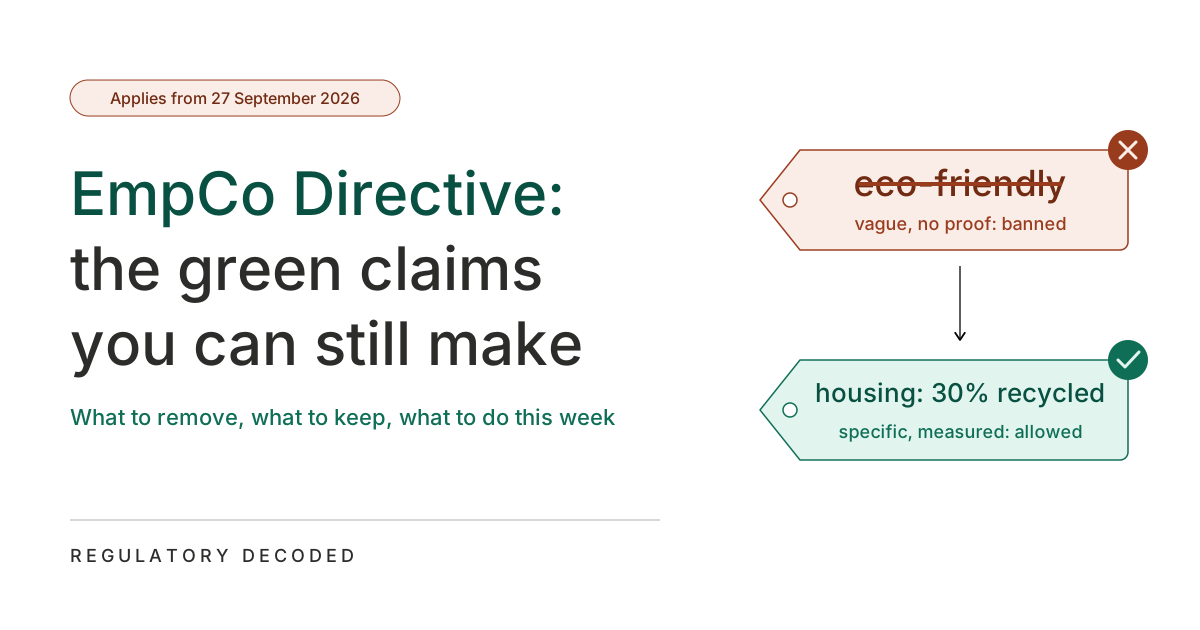
From 27 September 2026, the EmpCo Directive turns a vague “eco-friendly” on a consumer product into an automatic violation across the EU.
You don’t need to read the legal text to comply. Most of the work is finding the green words on your packaging, datasheets and product pages, then deleting them, proving them or making them specific.
This guide shows what to remove, what you can still say, and what to do this week.
What does the EmpCo Directive change for your product?
Directive (EU) 2024/825, known as EmpCo, updates two existing EU consumer laws: the Unfair Commercial Practices Directive and the Consumer Rights Directive. The full text is on EUR-Lex.
In practice, it does two things. It bans a short list of green claims outright, and it forces you to tell buyers more about durability, repair and software updates before they buy.
Why “banned outright” matters
Most advertising rules need an authority to prove a consumer was misled. The claims below sit on the EU “black list” (Annex I of Directive 2005/29/EC), so the authority only has to show you made them.
Which green claims must you remove today?
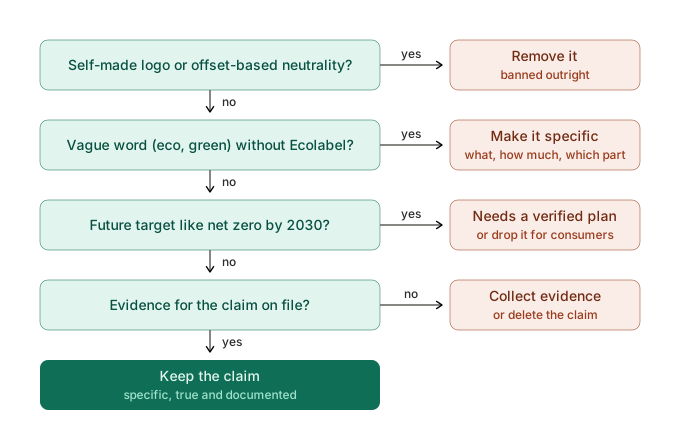
Five types of claim are now prohibited towards consumers, whatever the context. Check your materials for each one:
- Your own “eco” logo. A sustainability label is allowed only if it comes from an independent certification scheme or a public authority.
- Vague words without proof. “Green”, “eco”, “sustainable” or “climate friendly” need EU Ecolabel-level performance behind them.
- Part sold as whole. “Eco product” when only the packaging is recycled.
- Carbon neutral through offsets. “CO₂-neutral product” based on bought credits is banned, full stop.
- Legal minimum as a feature. “RoHS compliant” or “no banned substances” presented as an advantage, when every product must meet it.
If any of these appear on a surface a consumer can see, the fix is to delete them or back them with evidence, not reword them.
What green claims can you still make?
Specific, true and provable claims remain allowed. The rule of thumb: say exactly what, how much, and on what part of the product, on the same label or page.
Before and after examples
- “Eco-friendly kettle” → “Housing made from 30% recycled plastic”.
- “Sustainable packaging” → “Cardboard box, recyclable in paper collection”.
- “Energy-saving” → “Uses 0.3 W in standby” (backed by your test report).
- “Carbon neutral” → “Manufacturing emissions cut 20% since 2022” (backed by a life-cycle assessment).
Each “after” version is narrow and measurable. Keep the evidence in your technical file, because you will need it if the claim is challenged.
When a generic claim is still possible
You can still say “eco” or “green” if the product holds the EU Ecolabel, a national type I ecolabel recognised by a Member State, or top performance under EU law, such as the best class of an energy label.
What about targets like “net zero by 2030”?
Future claims are not banned, but they are now risky without paperwork. You need a public, detailed plan with measurable targets and dates, checked regularly by an independent expert whose findings are published (Article 6(2)(d)).
If you can’t produce that plan today, drop the target from consumer-facing material. Keep it for your sustainability report, where the rules are different.
What durability and software information do you now owe buyers?
The EmpCo Directive also tackles products designed to fail early. You can no longer hide that a software update will slow a device, claim a lifetime you can’t prove, or call a product repairable when it isn’t.
What to tell the buyer before purchase
Sellers must now show consumers the following, where it applies. Most of this data comes from you, the manufacturer:
- how long you will provide software updates for devices with digital elements;
- any durability guarantee you offer beyond two years, shown with the new EU harmonised label;
- the repairability score, where EU law sets one;
- whether spare parts are available, what they cost and how to order them.
Send this data to your retailers in a format they can reuse, because they must display it too, including online.
The new EU guarantee label
The label format is fixed by Implementing Regulation (EU) 2025/1960. It links directly to the repair duties in our EU Right to Repair Directive guide.
Keep your declared software-update period consistent with the support period you set under the Cyber Resilience Act. Two different numbers for the same product invite questions.
Does the EmpCo Directive apply to B2B products?
Not directly. It covers only communication to consumers. Claims made purely to professional buyers still fall under the older rules on misleading advertising between businesses (Directive 2006/114/EC).
The catch for B2B manufacturers
What counts is who can see the claim, not what the product is. If your instrument, tool or component is also sold on a marketplace or through a distributor that serves consumers, treat those materials as consumer-facing.
What happens if you get it wrong in Italy?
Italy applied the directive through Legislative Decree No. 30/2026, which updates the Consumer Code. The competition authority, AGCM, enforces it and can order the claim removed and published corrections.
How big are the fines?
The AGCM can fine up to €10 million per practice, or up to 4% of turnover for EU-wide infringements. It can suspend your business for up to 30 days, but only if you repeatedly ignore its orders.
What about stock already printed?
The Ministry of Enterprise (MIMIT) clarified in Circular No. 31671 of 27 August 2026 that old stock need not be destroyed. Stickers, shelf information and gradual packaging changes are acceptable if you document why. [VERIFY]
Other EU countries have their own national laws, and timing and wording vary. If you sell across Europe, check each country before a campaign.
Is the Green Claims Directive still coming?
Not for now. It would have required independent approval of every environmental claim before use. The Commission announced its withdrawal in June 2025, and negotiations stopped.
The proposal is technically still pending but frozen. If someone tells you “the Green Claims Directive requires this”, ask for the source: the rules that apply today are EmpCo’s.
What should you do this week?
A first pass takes a few days, not months. Work through these steps in order:
- Collect every packaging file, manual, datasheet, web page and marketplace listing sold to consumers.
- Search them for green words, logos, CO₂ claims and “compliant” used as a selling point.
- Delete what you can’t prove, and make the rest specific.
- Confirm your software-update period and durability guarantee, and send them to retailers.
- Store the evidence for every claim you keep in one folder.
That folder is your defence if the AGCM or a competitor challenges a claim.
Frequently Asked Questions
Can I still write “recyclable” on my packaging? Yes, if it is true in the countries where you sell and it refers only to the packaging, not the whole product.
Can I say my product is climate neutral? Not if it relies on carbon offsets. That claim is banned for products. Claims based on real emission cuts are allowed with solid evidence.
Does EmpCo apply to industrial or B2B equipment? Only to materials that reach consumers. Purely professional marketing follows the B2B misleading-advertising rules instead.
Do I have to destroy packaging printed before 27 September 2026? In Italy, not automatically. MIMIT accepts stickers and gradual replacement if you document the decision.
Conclusion
Vague green words, self-made eco logos and offset-based “carbon neutral” claims are now banned on consumer products in the EU.
Specific, measured claims backed by evidence are still allowed and are now worth more.
Buyers must also see software-update periods, durability guarantees and repair information before purchase.
The first AGCM decisions will show how strict enforcement becomes, so clean up now while fixes are still cheap.