Why hipot testing is mandatory for electrical product safety
In this article, we explain what a hipot test is, why we perform it, and what risks the test covers for user safety in products.
Before any electrical product reaches a user, one test stands between safe insulation and a potential shock hazard: the hipot test. Hipot testing, also called dielectric strength testing, is a mandatory checkpoint under IEC 60335, IEC 61010, and most national safety regimes. Not just a formality, it is the primary verification that insulation will hold under fault and surge conditions. By the end you will understand why test voltages run far above operating voltage and how the result maps to real user safety.
A failure here doesn’t just mean a failed product, it could mean an unsafe product in someone’s home or lab. We’ll explain what hipot test theory is, why it matters so much, and how it connects to the key international standards.
For the full physics behind how uncontrolled current reaches the user, and which thresholds cause pain, muscle lock, or cardiac disruption, see our guide to leakage current theory and physiological risks.
Theory and risks (you are here) → How to perform a hipot test → How to prevent hipot test failures
See also: Which IEC standard applies to your product
What is a hipot test and what does dielectric strength testing actually do?
Hipot test (short for “high potential”) is also known as the dielectric strength test. It is a non-destructive test. This test checks whether the insulation in your product can handle high voltages without breaking down. Think of pushing your insulation to the edge. This tests the effectiveness of the insulation measures in the product.
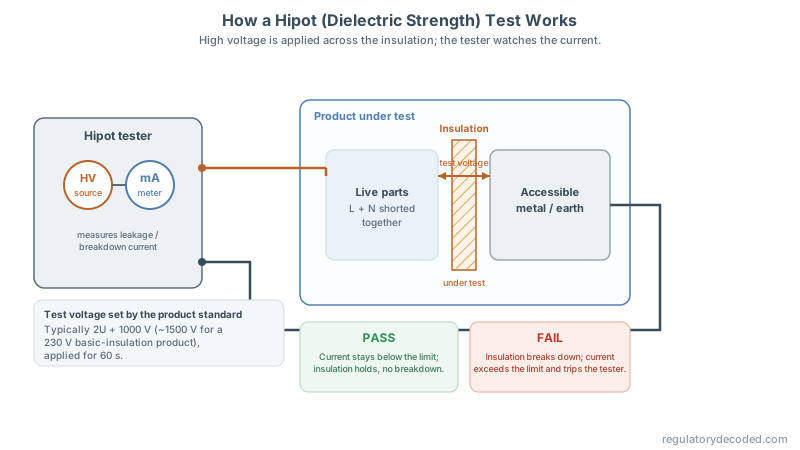
Here’s a basic diagram to help visualize the test:

During the test:
- A high voltage (typically 500 V to 5,000 V or more) is applied between live parts and exposed metal or ground.
- The insulation barrier must prevent any current from passing through, or a flashdown to happen.
- The test aims to verify the quality of the insulation barrier between live and accessible parts to prevent injuries.
The objective is to verify the quality of the barrier between live and touchable parts so that no fault can expose a user to dangerous voltage.
Why is dielectric strength testing mandatory for product safety?
Dielectric strength testing serves three purposes: preventing shock, validating build quality, and satisfying safety standards. Each is a distinct reason the test cannot be skipped.

1.1. It prevents electric shock.
The main goal of dielectric strength testing is to ensure safety. It confirms that a person will never touch an accessible part that becomes live due to insulation failure. This applies under every circumstance that your product can encounter throughout its life.
2. It verifies the design and manufacturing quality.
Production defects like wire pinching, contaminated boards, bad solder joints, or assembly errors can degrade insulation. This can happen even if your schematic is safe. External uncontrollable events include thunderstorms, power failures, or line disturbances. These can create potentially dangerous situations that the product must withstand safely.
By testing during assembly, you can ensure product safety. Testing during product certification also prevents potential defects. This ensures that such defects will never hurt the user.
3. It satisfies safety standards.
Insulation barriers are a crucial aspect of every device involving electricity. No serious electrical safety compliance route skips this step. It’s a mandatory test under most IEC and national standards. It is considered one of the basic tests to guarantee the safety of every electrical device.
How does insulation break down? Corona discharge, partial discharge, and arc-over
Insulation materials, like air gaps, plastics, varnishes, or composite structures, can break down. This happens when the applied electric field exceeds a critical threshold. This field is calculated as:
Electric Field (E) = Voltage (V) / Distance (d)
For a fixed gap, say 2 mm, excessive voltage raises the field until it begins to ionize surrounding air, break molecular bonds in the insulator, and trigger partial discharge.
- Ionize the surrounding air (leading to corona discharge)
- Break molecular bonds in the insulating plastic
- Trigger partial discharge, which leads to tracking and eventual arc-over
Once breakdown voltage starts, the insulation no longer recovers. This isn’t a glitch. It’s permanent damage. It creates a dangerous path for current to reach surfaces a user can touch.
Design choices can stop this breakdown from happening; for those measures, see how to prevent hipot test failures.
What happens to the user if insulation fails?
If dielectric insulation fails in use, the result can be severe or even fatal. The outcome of an electric shock depends on four factors, listed below.
Hipot Test Theory: the Electric Shock
An electric shock occurs when current flows through a person’s body. The severity depends on:
- Current (mA): Even 10 mA can cause muscle contractions. (more about leakage current here)
- Duration: Longer shocks increase risk of burns and fibrillation.
- Path: Current passing through the heart or brain is the most dangerous.
- Frequency: 50–60 Hz AC (common in homes) is especially lethal due to interference with heart rhythms.
| Current (mA) | Effect on Human Body |
|---|---|
| 1 mA | Barely perceptible |
| 5 mA | Painful shock |
| 10–20 mA | Muscle lock-up |
| 50–100 mA | Ventricular fibrillation (often fatal) |
| >200 mA | Burns, internal damage, cardiac arrest |
IEC standards like IEC 60335 and IEC 61010 are built on this data. They set test voltages sufficiently high. This ensures that a product’s insulation will not allow dangerous leakage. This holds true even under fault conditions.
Understanding dielectric stress: the dam analogy and voltage safety margins
To appreciate the importance of this test, we have to visualize the electrical stress placed on an insulator. In any powered device, the insulation is constantly being “pushed” by the voltage potential. This includes the plastic casing of a wire, a mica sheet in a heating element, or the FR4 material of a PCB. When we perform a dielectric strength test, we are artificially increasing that pressure to see where the material might crack.
Think of insulation like a dam holding back a reservoir of water. The working voltage of 230 V is the standard water level. A Hipot test at 3000 V is like a simulated flood. We are checking to see if there are any leaks, structural weaknesses, or microscopic cracks that could give way when the pressure rises unexpectedly. If the dam holds at 3000 V, we can be confident it will remain safe at 230 V for many years.
When evaluating your insulation barriers, consider these three physical factors:
- Dielectric Constant: Different materials resist electrical flow with varying levels of efficiency, which dictates how thick a barrier needs to be.
- Homogeneity: A tiny air bubble trapped inside a molded plastic part during manufacturing can act as a localized point of failure under high voltage.
- Surface Contamination: Dust, moisture, or even oils from a technician’s fingerprints can create a “bridge” for electricity to crawl across an otherwise safe surface.
By acknowledging these physical realities, we move from a mindset of “passing a test.” We shift to a mindset of “building a robust product.” Quality technicians understand that a product passing with a low leakage current is much safer. It is significantly safer than one that barely meets the limit.
Why is the hipot test voltage higher than the working voltage?
A key question from new engineers is: “If my product runs at 230 V, why test it at 1,250 or 3,000 V?”
The answer is safety margin plus surge simulation.
The answer is twofold:
- Safety Margin: Insulation may degrade over time due to heat, vibration, contamination, or humidity.
- Surge Simulation: Surges in real life can reach thousands of volts. The test ensures no flashover or arc path can form inside the product.
Standards Guidance
Standards specify required test voltages based on working voltage, insulation type (basic, supplementary, or reinforced), and pollution category. These values aren’t arbitrary; they are derived from decades of accident data and insulation failure analysis.
To find the exact level that applies to your device, see which IEC standard applies to your product.
What overvoltage conditions does the hipot test simulate?
A frequent question from junior engineers is why we test at 3000 V for a 230 V device. To the uninitiated, this seems like over-engineering. However, the electrical grid is a noisy, violent environment. Switching inductive loads (like an industrial motor next door) or atmospheric events can send “transients” or “spikes” through the lines that far exceed the nominal operating voltage. Also, a lightning could strike next to our house, creating devastating overvoltages.
Your insulation is only rated for 230 V. It will fail the first time a neighbor turns on a heavy-duty air conditioner. A dielectric strength test validates that the product won’t become a hazard during these common grid events. We aren’t testing for the “sunny day” scenario; we are testing for the “stormy night” scenario.
Standardized testing levels allow us to account for:
- Overvoltages (Category II/III): Different environments (homes vs. factories) have different levels of expected surge potential.
- Aging and Wear: Plastics become brittle over time due to UV exposure and heat; the safety margin we test for today accounts for the degradation of tomorrow.
- Mechanical Stress: Vibration in a blender or a power tool can cause wires to rub against each other; the test verifies that the insulation is tough enough to handle that friction.
By applying these high voltages, we essentially “stress-test” the integrity of the assembly. This method efficiently catches a wire that was pinched during assembly. It also detects a screw that was driven too deep into a transformer winding.
The human factor: let-go threshold, impedance control, and double insulation
Regulatory standards are not just numbers pulled from thin air; they are deeply rooted in the study of human electro-pathology. The human body is essentially a bag of salty water, making it an excellent conductor of electricity. When a dielectric barrier fails, the body becomes a component in the circuit, and the results are dictated by the laws of physics.
The “muscle lock-up” or “let-go” threshold is a critical concept in safety engineering. At around 10 mA to 20 mA of AC current, external current overrides the electrical signals from the brain to the muscles. This means a person might be unable to let go of a hot wire, even if they are conscious of the danger. This is why Hipot testers monitor “leakage” so strictly. They ensure that even in a worst-case scenario, the current remains below these physiological triggers.
Here is how these physiological limits translate into design requirements:
- Impedance Control: Protective grounding must be low enough in impedance to divert current away from a person and toward the earth.
- Redundancy: “Double Insulation” (Class II) provides two independent layers of protection, so that if one fails, the second still prevents a lethal shock.
- Isolation: Transformers and optocouplers create physical gaps that prevent dangerous potentials from ever reaching the “user-facing” side of the electronics.
When we test at high potentials, we verify that these layers of defense are thick enough. They must also be pure enough to withstand the stresses of a 10-year product lifespan. It is a commitment to the “Duty of Care” that every manufacturer owes to their customers.
External Sources for Deeper Learning
- TDK Lambda – Hipot Testing in Power Supplies
- In Compliance Magazine: The Dielectric Withstand (Hi-pot) Test
- IEC 60335-1 (Household Safety Requirements)
- IEC 61010-1 (Lab Equipment Safety)
Key takeaways: hipot testing as the primary insulation safety checkpoint
Hipot testing isn’t optional, it’s your product’s main line of defense. It confirms your insulation can handle the unexpected. It keeps users safe. And it proves that what you built is not just functional, but fundamentally safe.
It connects material science with human physiology and bridges design intent with real-world protection. We live in a world of ever-thinner devices and ever-higher energy densities. This test remains one of the most important checkpoints in product development.
Next up in the series, we’ll break down the exact steps of how to perform a hipot test. We will also discuss the technical decisions involved in performing a proper hipot test. Our goal is to avoid both over and under-testing.