
A product that performs flawlessly on the bench and ships on schedule can still fail its EMC certification due to a filter capacitor in the wrong position, a common mode choke chosen without checking its impedance curve, or a Y-capacitor value that solves the EMC problem while creating a leakage current violation.
Conducted emissions failures are among the most common reasons for EMC retest, and the majority trace back to filter design decisions made early in the design process. This article covers the four areas that determine whether your filter works in the test lab: common mode choke selection, X and Y capacitor sizing, filter placement at the power entry point, and the direct trade-off between Y-capacitor value and leakage current limits under IEC 62368-1 and IEC 60335.
What Are You Actually Filtering?
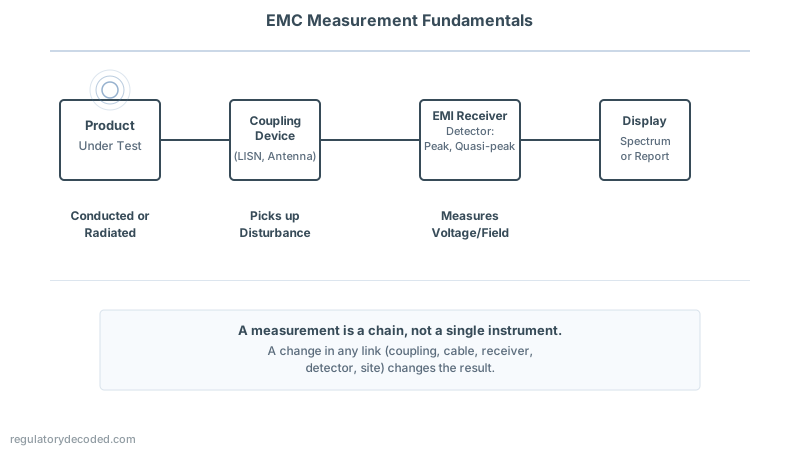
Before selecting any component, you must understand the noise you are trying to suppress. If you are new to the emission vs immunity framework or the conducted vs radiated split, see Understanding EMC: The Basics first. Conducted emissions testing covers the frequency range 150 kHz to 30 MHz, as required by standards including CISPR 32 (EN 55032), The LISN (Line Impedance Stabilisation Network) presents a 50 Ω impedance at the mains port and measures both differential mode and common mode disturbance voltages.
The CISPR 32 Class B limits for conducted emissions are:
- 66 dBµV quasi-peak and 56 dBµV average from 150 kHz to 500 kHz
- 56 dBµV quasi-peak and 46 dBµV average from 500 kHz to 5 MHz
- 60 dBµV quasi-peak and 50 dBµV average from 5 MHz to 30 MHz
A switch-mode power supply without any filtering will typically generate conducted noise in the range of 70 to 90 dBµV at 150 kHz. That means your filter must achieve 20 to 30 dB of attenuation at the critical lower end of the frequency band, with additional margin to account for measurement uncertainty and production variation.
Differential mode (DM) noise travels from line to neutral. It originates from high-frequency switching currents in the power converter. Common mode (CM) noise travels from both line and neutral to earth. It originates from parasitic capacitance between switching nodes and the chassis or ground reference. Both paths must be addressed. A filter that targets only one type will not pass formal testing.
Note: If you are not certain whether your product’s emissions are primarily DM or CM, a dual-LISN pre-compliance scan separating the sum and difference of both line voltages will tell you where to direct your attenuation effort.
Common Mode Choke Selection
The common mode choke (CMC) is the primary tool for suppressing common mode conducted emissions. It consists of two windings on a shared ferrite core. For CM currents, the fluxes from the two windings add, presenting high impedance. For differential mode load current, the fluxes cancel, leaving the power circuit essentially unimpeded.
What to Check Before Choosing a Choke
The impedance vs. frequency curve is the most important parameter in CMC selection. Most power line CMCs are specified with a nominal CM inductance of 1 mH to 10 mH. However, inductance alone does not tell you whether a choke will actually attenuate your noise. The choke’s impedance at the frequencies where your product’s emissions peak is what determines performance.
Key parameters to evaluate when selecting a CMC:
- CM impedance at your trouble frequency: Verify the datasheet impedance curve covers your switching frequency and its harmonics, typically 150 kHz to 5 MHz for most SMPS designs.
- Self-resonant frequency (SRF): The choke must have its SRF above the frequency range you want to attenuate. Above the SRF, the winding capacitance dominates and the component loses its filtering function.
- Rated current and DC resistance (DCR): Select a choke with a current rating of at least 1.5 times the maximum expected line current. Higher DCR increases thermal dissipation and voltage drop, which matters in efficiency-critical designs.
- Leakage inductance: The leakage inductance (typically 1 to 5% of CM inductance) also contributes DM filtering. This is useful but must be confirmed against DM noise requirements, not relied upon as the sole DM filter element.
- Core material: Manganese-zinc (MnZn) ferrites offer good impedance from around 100 kHz to 10 MHz. Nanocrystalline cores provide higher impedance per unit volume in the same range and are preferred where board space is constrained.
The impedance required from the CMC depends on the margin between your pre-compliance scan and the applicable limit line. For 20 dB of CM attenuation, you need the CMC to present significantly more than 50 Ω at the noise frequency (since the LISN source impedance is 50 Ω). Consult the CM attenuation formula and iterate with your Y-capacitor values as a combined filter network.
Tip: Never select a CMC from its inductance value alone. Download the impedance curve from the manufacturer’s datasheet and overlay it with your pre-compliance scan to confirm adequate attenuation margin.
X and Y Capacitor Sizing
Differential Mode Filtering
X capacitors connect directly across the mains, from line to neutral. Their purpose is to suppress differential mode noise. They are designated X1 or X2 depending on their rated AC voltage and pulse withstand category, with X2 (rated 275 VAC) being the standard choice for most mains-connected equipment.
X capacitor values typically range from 100 nF to 1 µF. Higher values provide greater DM attenuation but increase inrush current at power-on and raise cost and board space requirements. For products subject to inrush current limits, this trade-off must be considered explicitly.
X capacitors connected on the mains side of the CMC (between the mains and the choke) provide pre-filter DM suppression. X capacitors on the load side of the choke, in combination with the choke’s leakage inductance, form the low-pass LC stage that attenuates higher-frequency DM noise before it reaches the power converter.
Y Capacitors: Common Mode Filtering
Y capacitors connect from line or neutral to the protective earth (PE). For Class I equipment in EU markets, Y2 capacitors (rated 250 VAC, qualified to IEC 60384-14) are the standard designation. They suppress CM noise by providing a low-impedance return path to earth for high-frequency CM currents.
The constraint on Y capacitor values comes from leakage current. Every Y capacitor creates a current path from the mains conductors to the protective earth conductor. This current flows continuously during normal operation. The formula is:
I = 2π × f × C × V
Where:
- I is the leakage current in amperes
- f is the mains frequency (50 Hz, or 60 Hz for worst-case global products)
- C is the total Y capacitance connected to earth, in farads
- V is the RMS line voltage
Using this formula, a single 33 nF Y2 capacitor across a 250 VAC, 50 Hz supply generates approximately 2.6 mA of leakage current. A 47 nF capacitor generates approximately 3.7 mA. Two capacitors of the same value, one from line to PE and one from neutral to PE, contribute their combined capacitance to the total.
The Y-Capacitor and Leakage Current Trade-Off
This is the most consequential constraint in EMC filter design for mains-connected Class I products. The conflict is direct: better CM filtering requires larger Y capacitance, but larger Y capacitance generates more leakage current to the protective earth. The Y-capacitor case is one of several structural conflicts between EMC and electrical safety requirements — Balancing Electrical Safety and EMC Compliance covers the full set, including creepage vs loop area and insulation vs ground continuity.
Under IEC 62368-1 (the current safety standard for audio, video, and information technology equipment), the touch current limit under normal operating conditions is:
- 0.25 mA for hand-held equipment
- 3.5 mA for permanently connected equipment or equipment connected via a power cord
Under IEC 60335-1 (household appliances), the protective conductor current limits vary by appliance class. Portable Class I appliances are limited to 0.75 mA. Stationary motor-driven Class I appliances may be allowed up to 3.5 mA under certain conditions. Always check the specific sub-clause applicable to your product category.
These limits apply to the total leakage current at the protective earth conductor, not just the contribution from Y capacitors. Other contributors include transformer interwinding capacitance, PCB parasitic capacitance between primary and secondary circuits, and filter inductor winding capacitance. The Y capacitor budget must account for these other paths.
Practical Implications for Filter Design
In a typical Class I product at 230 VAC, 50 Hz, the combined Y capacitance that produces 3.5 mA of leakage is approximately 48 nF. That is the absolute ceiling before the filter pushes the product close to or over the limit. Production tolerances of ±20% on Y capacitor values, combined with mains voltage variations and frequency variation, mean the practical working limit is typically around 33 to 47 nF total Y capacitance.
| Total Y‑capacitance | Leakage @ 264 V, 50 Hz | Leakage @ 264 V, 60 Hz |
|---|---|---|
| 1 nF | 0.08 mA | 0.10 mA |
| 2.2 nF | 0.18 mA | 0.22 mA |
| 3.3 nF | 0.27 mA | 0.33 mA |
| 4.7 nF | 0.39 mA | 0.47 mA |
| 10 nF | 0.83 mA | 1.00 mA |
| 22 nF | 1.82 mA | 2.19 mA |
| 33 nF | 2.74 mA | 3.28 mA |
| 47 nF | 3.90 mA | 4.68 mA |
This directly constrains the CM attenuation available from the Y capacitors alone. If your pre-compliance scan shows significant CM noise and the Y capacitor budget is exhausted, the remaining attenuation must come from the CMC. Higher CM inductance in the choke, or a two-stage filter with inductance split across two chokes, provides more CM attenuation without increasing leakage current.

Tip: Calculate your leakage budget explicitly before specifying any Y capacitor value. Total the estimated contributions from all capacitive paths to earth, then allocate what remains to the Y capacitors in the filter. Do not leave this to the lab stage.
Note: Products with a warning label indicating high leakage current (“Warning: High leakage current. Connect to earth before connecting to supply”) may be permitted to exceed the 3.5 mA limit under EN 60950-1 or equivalent, but this is only permissible for stationary, permanently connected equipment with a minimum protective earth conductor cross-section. It is not an option for portable or user-connected products.
Filter Placement at the Power Entry Point
The position of the EMC filter within the product is as important as its component values. A filter placed in the wrong location provides little or no benefit, regardless of its attenuation specification.
The filter must be placed at the point where the mains cable enters the product, as close to the power entry connector as physically possible. The reason is topological: if the unfiltered mains wiring runs inside the enclosure before reaching the filter, those conductors become antennas for internal noise sources. Noise generated by the switching supply can couple directly onto the mains conductors before the filter has any chance to act on it.
The critical layout requirements for effective filter placement are:
- Minimize input lead length: The distance between the mains connector and the first filter component must be as short as possible. Any conductor length on the mains side of the filter is outside the filter’s influence.
- Separate filter input and output wiring: If the input (mains side) and output (converter side) conductors of the filter run in parallel on the PCB, noise can couple magnetically or capacitively from the output back to the input, defeating the filter’s attenuation. Physical separation of at least 10 mm is a common minimum, and a grounded copper shield between the two sides significantly improves isolation at higher frequencies.
- Ground the filter case or shield directly to the chassis PE: For through-hole or screw-mounted filter modules, the mounting tabs must connect to the chassis ground reference, not to PCB ground. This provides the low-impedance PE path required for Y capacitor function.
- Use short, direct connections to the Y capacitor earth return: Long traces from the Y capacitors to the earth reference add inductance to the return path and reduce filter effectiveness at the frequencies that matter most.
Where a commercial off-the-shelf EMC filter module is used instead of a discrete filter, the same principles apply. The module input must connect directly to the IEC inlet or mains terminal, and the module chassis pin must bond directly to the metal enclosure or the PE terminal, not through a PCB trace.
For products where the PCB integrates the filter without a separate module, the filter stage should be treated as a distinct zone with its own copper pour connected to PE. The mains entry zone, the filter zone, and the power converter zone should be separated by physical distance and, where layout permits, by copper barriers tied to PE.
How This Connects to Leakage Current and Hipot Testing
The filter design is not independent of the product’s overall leakage current and dielectric strength performance. Changes made to pass conducted emissions can create problems in the safety test programme.
Increasing Y capacitor values raises leakage current, as discussed above. Adding a second filter stage increases the total capacitance connected between the mains and earth. The cumulative effect must be modelled and verified against the applicable standard before committing to a filter design.
Hipot (dielectric strength) testing places high voltage between the mains conductors and the earth reference. Y capacitors will carry high charging current during this test. Capacitors that are not rated for the test voltage may fail, and capacitors that are rated but excessively large may trip the test equipment’s leakage current cutoff before a fault has actually occurred. Check the hipot test voltage requirements against the Y capacitor rated voltage and ensure the test current limit on your hipot tester is set appropriately.
The article Understanding Leakage Current Part 3: Design and Mitigation Strategies covers the broader leakage current design problem in detail, including insulation, PCB layout, and protective earthing strategies that interact directly with filter design decisions.
Verification Before the Test Lab
A filter that is correctly designed and placed should show measurable improvement in pre-compliance conducted emissions scans. The following checks are useful before submitting to formal testing.
The minimum verification steps before formal conducted emissions testing:
- Pre-compliance scan with LISN: Measure emissions on a bench LISN before and after filter installation. Confirm that attenuation is at least 6 dB below the applicable limit line at every frequency point, to account for measurement uncertainty.
- Leakage current measurement: Measure protective conductor current (earth leakage) per IEC 60990 at nominal voltage and frequency. Verify the result is below the limit for your product category with a margin for production tolerance.
- Filter self-heating check: Run the product at maximum load for 30 minutes and verify that the CMC does not overheat. Excessive temperature indicates that the rated current was not met, or that DCR is too high.
- CM versus DM noise separation: If emissions remain close to the limit after filtering, identify whether the remaining noise is CM or DM and confirm you have targeted the correct path.
For a deeper treatment of measurement uncertainty in EMC testing and how to interpret borderline results, the article Why EMC Measurement Uncertainty Is So High explains why margin matters more in EMC than in almost any other measurement discipline.
The official CISPR 32 standard and its national adoptions are published by the IEC and available via the IEC Webstore, which also provides EN 55032 and other harmonised standards referenced in the EU EMC Directive 2014/30/EU.
Frequently Asked Questions
What is the difference between an X capacitor and a Y capacitor? X capacitors connect across the mains line and neutral to suppress differential mode noise. Y capacitors connect from line or neutral to protective earth to suppress common mode noise. Y capacitors are more tightly restricted in value because they generate leakage current to earth.
How do I calculate Y capacitor leakage current? Use the formula I = 2π × f × C × V, where f is mains frequency (50 or 60 Hz), C is the total Y capacitance in farads, and V is the line voltage. For 33 nF at 250 VAC, 50 Hz, the result is approximately 2.6 mA. Multiply by the number of Y capacitors contributing to the earth path.
Why does my product pass safety testing but fail conducted emissions? Safety and EMC are tested independently. A product can meet leakage current limits with small Y capacitors but still fail conducted emissions because those capacitors provide insufficient CM attenuation. The solution is usually a better common mode choke or a two-stage filter topology.
Where should I place the EMC filter in my product? Place the filter at the mains entry point, as close as physically possible to the power connector. Separate the filter input and output conductors to prevent noise bypass coupling. Bond the filter’s earth connection directly to the metal chassis, not through a PCB trace.
Can I use a commercial EMC filter module instead of a discrete design? Yes, and for many products this is the faster and lower-risk approach. Verify that the module’s rated attenuation meets your requirements at the critical frequencies, check its leakage current specification against the applicable safety standard, and confirm that the mounting and grounding method delivers the stated performance.
Conclusion
EMC filter design for conducted emissions requires three things to go right simultaneously: the right component values, the right component types (including safety certification for X and Y capacitors), and the correct physical placement. Of these, placement is the most commonly underestimated. A filter positioned 200 mm from the mains entry point, with unfiltered mains wiring running inside the enclosure, will perform significantly worse than its datasheet suggests.
The Y-capacitor leakage current constraint is the single most important trade-off to resolve early. Calculate your leakage budget before specifying Y capacitor values, account for all capacitive paths to earth, and confirm that the remaining allowance is sufficient to achieve your CM attenuation target. If it is not, the answer is a better CMC, not a larger Y capacitor.
Conducted emissions are a design problem. The test lab confirms whether the design decisions were correct. Treating them as a certification problem to be solved at the test stage is the most reliable way to generate a retest bill.