
Designing a safe and compliant product involves understanding the maze of standards and regulations that apply to your device. Whether you’re developing consumer electronics, industrial equipment, or medical devices, knowledge of key standards and directives is essential for success. This guide explains the most relevant international standards. It highlights their application by product category. It also provides practical insights to help design teams stay compliant from the start.
Why Standards and Directives Matter
Standards and directives are not just legal requirements—they are structured frameworks based on expert consensus. They offer:
- Safety benchmarks to prevent electrical shock, fire, or injury
- EMC criteria to guarantee devices don’t interfere with other equipment
- Design guidance to promote reliability and quality
- Market access: Products must comply with these rules to be sold in most countries
Reader Reflection: What markets do you plan to enter, and which regulations apply to each?
Key Safety Standards and Their Relevance
62368-1:2023
- Scope: Audio/video, information and communication technology equipment
- Applies To: Computers, monitors, routers, AV gear
- Why It Matters: Replaces legacy standards (IEC 60065, IEC 60950), introducing hazard-based safety engineering (HBSE)
- The challenges: Is a recent standard and it’s developed around risk assesement strategy
60335-1:2020
- Scope: Household and similar electrical appliances
- Applies To: Hair dryers, coffee machines, vacuum cleaners
- Why It Matters: Covers mechanical, thermal, and electrical safety. Specific sub-parts define safety for product families (e.g., IEC 60335-2-9 for toasters)
61010-1:2020
- Scope: Measurement, control, and lab equipment
- Applies To: Multimeters, oscilloscopes, lab automation systems
- Why It Matters: Emphasizes insulation requirements, transient protection, and environmental conditions
Key EMC Standards and Product Types
IEC 61000-4 Series (Immunity Testing)
- Examples:
- 61000-4-2:2020: Electrostatic discharge (ESD)
- 61000-4-3:2020: Radiated RF immunity
- 61000-4-5:2023: Surge immunity
- Applies To: All electrical and electronic equipment
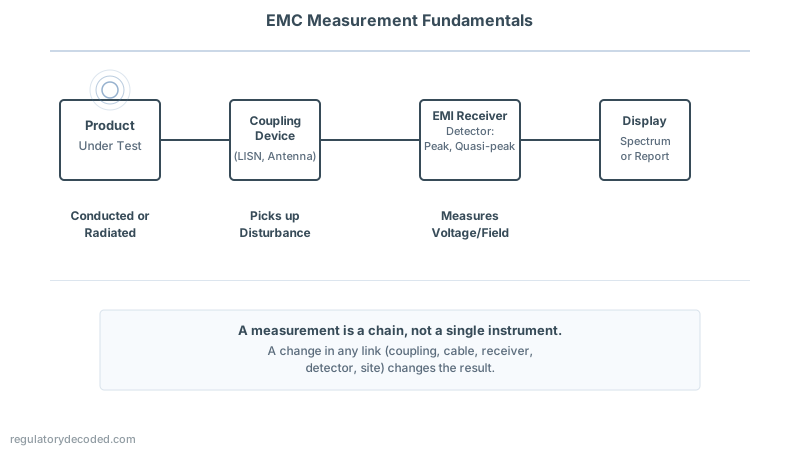
- Why It Matters: These are the core building blocks of EMC testing
CISPR 32 / EN 55032:2022
- Scope: Multimedia equipment emissions
- Applies To: TVs, laptops, tablets
- Why It Matters: Ensures devices don’t emit RF noise that affects radio, Wi-Fi, or other electronics
EN 55035:2021
- Scope: Multimedia equipment immunity
- Applies To: Same as above
- Why It Matters: Complements CISPR 32 by ensuring the device can tolerate RF environments
FCC Part 15 (USA)
- Scope: Radio frequency devices
- Applies To: Almost all electronic devices sold in the U.S.
- Why It Matters: Ensures emission limits for unintentional radiators (Subpart B) and intentional radiators (Subpart C)
Case Study: A Bluetooth speaker passed CISPR 32 and EN 55035 in the EU. However, it failed FCC Part 15 Subpart C due to excessive harmonics. Early testing revealed the issue, and firmware changes resolved it, avoiding expensive re-certification delays.
Directives in the EU Market
Low Voltage Directive (LVD) 2014/35/EU
- Applies To: Electrical products operating from 50V–1000V AC or 75V–1500V DC
- Key Link: Ensures products are safe to use
EMC Directive 2014/30/EU
- Applies To: All electronic and electrical products
- Key Link: Devices must not interfere with or be affected by other equipment
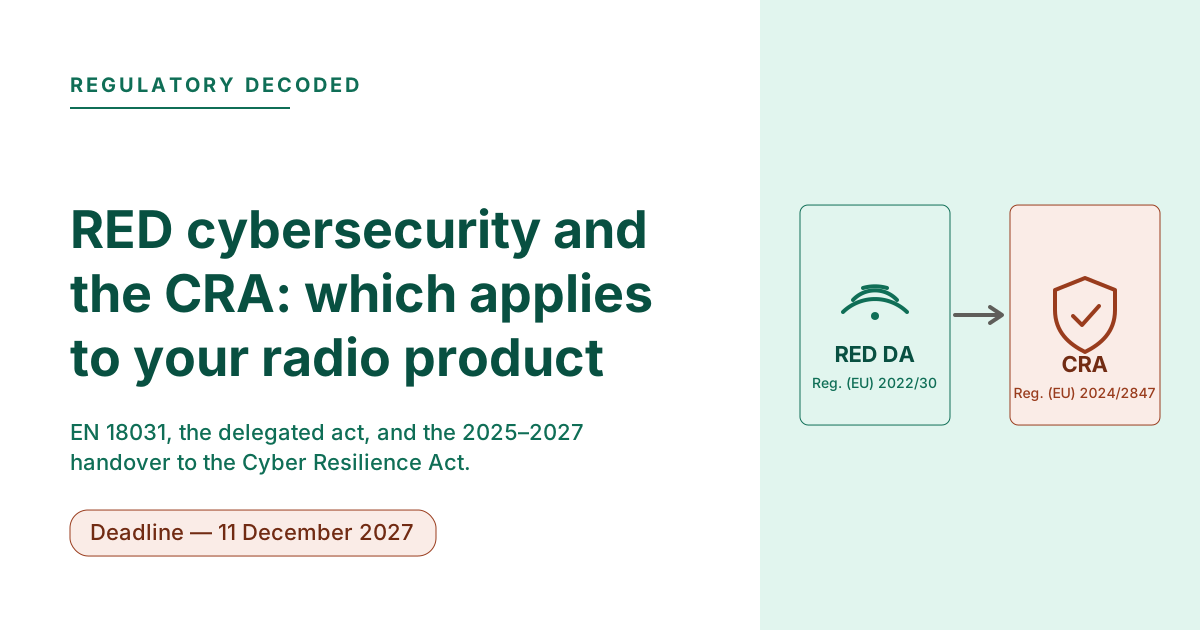
Radio Equipment Directive (RED) 2014/53/EU
- Applies To: Devices with wireless communication (Wi-Fi, Bluetooth, LTE)
- Key Link: Includes both safety and EMC aspects, plus spectrum efficiency
Finally, a Scenario Challenge: If your product has a Wi-Fi module, is it compliant with RED? Ensure it complies not just with EMC or LVD.
To furthet understand and Access to European Union law see this EU link
Organizing Standards by Product Category
| Product Type | Safety Standard | EMC Standard | Directive/Regulation |
|---|---|---|---|
| Home Appliance | IEC 60335-1 | IEC 61000-4, CISPR 14-1/2 | LVD, EMC Directive |
| IT/AV Equipment | IEC 62368-1 | CISPR 32 / EN 55032 | LVD, EMC Directive |
| Lab Instruments | IEC 61010-1 | IEC 61000-4, EN 61326-1 | LVD, EMC Directive |
| Wireless Devices | IEC 62368-1 / RED | ETSI EN 301 489-1/-17 | RED |
| Industrial Controls | IEC 61010, EN 60204-1 | IEC 61000-6-2/-4 | LVD, EMC Directive |
Best Practices for Managing Compliance
- ✅ Start with a compliance plan: Identify applicable standards and build a checklist.
- ✅ Involve regulatory experts early: Avoid redesigns by consulting during concept phase.
- ✅ Use pre-compliance testing: Validate emissions, immunity, and safety incrementally.
- ✅ Document every decision: Helps during CE marking or FCC filing.
- ✅ Simulate and prototype early: Helps identify risks and reduce test failures.
References and Further Reading
- IEC Standards Overview
- European Commission Directives
- FCC Equipment Authorization
- CENELEC Standards Access
Key Takeaways
- ✅ Standards define the design envelope—start with them, not after the prototype.
- ✅ Match standards to your product type and market.
- ✅ Understand the difference between safety, EMC, and radio compliance.
- ✅ EU directives and U.S. regulations differ—know both if you’re selling internationally.
- ✅ Good documentation, early testing, and proactive design reduce delays and failures.
Have you mapped all the applicable standards to your product? Do you have a compliance checklist in your design documentation? Now’s the time to build it.