
How to Design for Safety
In Part 1, we explored what a hipot test verifies. In Part 2, we covered how to perform a hipot test according to IEC standards. Now, in Part 3, we address the crucial final stage: what to do when a hipot test failure arises and how to design with insulation strength in mind.
Hipot test failures can reveal deep design flaws, process inconsistencies, or aging effects that certification testing may not catch. This article will help you diagnose, prevent, and engineer against them.
What a hipot test verifies → How to perform a hipot test → How to prevent hipot test failures (you are here)
See also: Which IEC standard applies to your product
What Does Dielectric Testing Actually Verify?
Before we can fix a failure, we have to agree on what we are actually testing. It is a common misconception that Hipot testing is simply looking for a short circuit, but it is far more nuanced than that.
The primary goal of a Dielectric Withstand test is to verify the integrity of the insulation barrier. It assesses the separation between the mains input (primary circuit) and the user-accessible parts (secondary circuit or chassis). By applying a voltage significantly higher than the operating voltage, we are stressing the insulation to ensure it has adequate margin.
- Dielectric Strength: Does the insulation hold the voltage without breaking down (arcing)?
- Leakage Current: Is the current flowing through the insulation below a specific safety threshold?
- Spacing Integrity: Are the Clearance (air gap) and Creepage (surface distance) maintained?
It is vital to distinguish this from the Insulation Resistance (IR) test. While IR measures the resistance in Mega-ohms at a lower DC voltage, Hipot looks for breakdown under high stress (often AC). A unit can pass an IR test and still fail a Hipot test if a small air gap arcs over at high voltage.
What Causes Hipot Test Failure
Hipot test failures are all linked to an insufficient level of insulation for the given test value. This kind of failure can result in different symptoms (and causes). Three common categories can be registered:
- Insulation breakdown – Dielectric material cannot withstand the voltage; may result in visible arc-over.
- Flashover due to contamination – Dust, humidity, or residue reduces surface resistance and can degrade the dielectric properties of the material used.
- Creepage or clearance failure – Inadequate distances between live and grounded parts, usually results in visible flashovers.
These failures are more likely when:
- The product is used (and tested) in a humid or high-altitude environment
- Components were damaged during assembly or testing
- PCB layout has sharp edges, tight spacing, or conductive debris
Diagnosing a Hipot Test Failure
When a product fails a hipot test you usually hear a clear noise, or the test machine stops. When it happens:
- Look for visible marks like burn spots or melted traces
- Use insulation resistance testing to check degradation over time
- Check for repeatability – does it fail at the same spot? Is it batch-specific?
- Inspect surface conditions – clean and re-test if contamination is suspected
Try to limit the amount of retests on the same samples. Repeating the hipot test can damage the board and create conditions that are no longer representative of a real case scenario, resulting in a fake “PASS” or in breakdown in new areas. When in doubt, repeat the test on a fresh sample.
💡 Tip: A pass in dry lab conditions doesn’t guarantee long-term safety. Re-test under humidity or temperature working conditions to validate real-world durability.
Analyzing the Root Causes: Why Do We Fail?
When looking at the data, failures generally fall into three buckets: design flaws, component limitations, and manufacturing defects. Let’s break down the most common culprits identified in failure analysis trees.
1. The Component Factor: Capacitors and Semiconductors
One of the most frequent questions we encounter is, “How do you know if a MOSFET is bad?” or “What is the most common capacitor failure?” in the context of Hipot.
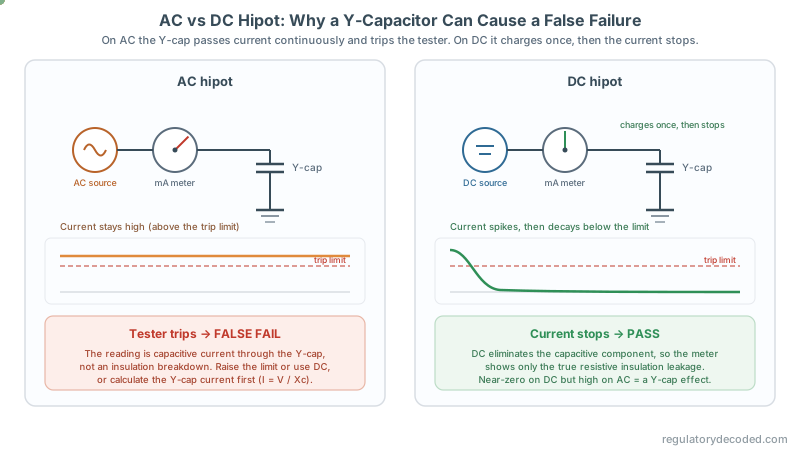
Designers often place Y-capacitors (line-to-ground) to mitigate EMC (Electromagnetic Compatibility) issues. However, these capacitors provide a direct path for AC current to flow during a Hipot test. If your Y-caps are too large, your Hipot tester will measure this current as leakage and trip, resulting in a “false” failure. The insulation is fine, but the capacitive reactance is allowing too much current to pass.
Similarly, power semiconductors like MOSFETs can be the source of failure if they are mounted on heatsinks that are grounded. The insulation sheet (thermal pad) between the MOSFET and the heatsink is a critical dielectric barrier. If this pad is punctured by a burr on the heatsink, or if the screw torque is too high, the Hipot voltage will arc through the component casing to the ground.
Key Mitigation Strategies for Components:
- Calculate Maximum Capacitance: Before testing, calculate the theoretical leakage current of your Y-caps (I = V / Xc). If the theoretical current exceeds the tester’s trip limit, you must adjust the limit or use DC Hipot testing (where capacitors charge up but do not flow continuous current).
- Check Thermal Pads: Inspect the mounting process for power transistors. A common failure mode is a microscopic metal shaving piercing the silicone pad.
2. Spacing Violations: The Invisible Enemy
“What causes high leakage current?” or “What causes an unintentional voltage drop?” often leads us to spacing issues.
In the world of electrical safety, Clearance is the shortest distance through air between two conductive parts, and Creepage is the shortest distance along the surface of the insulating material. If a manufacturing process leaves a flux residue, or if a cable is routed too close to a sharp metal edge, the effective creepage distance is reduced.
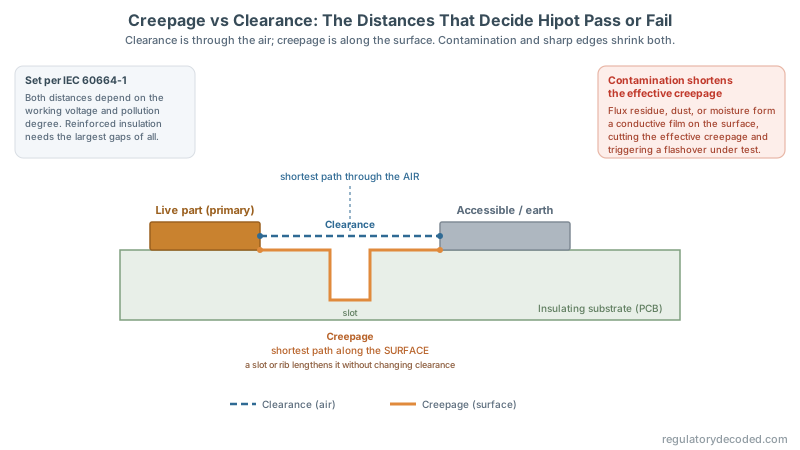
During a Hipot test, high voltage can ionize the air in a small gap, creating a conductive plasma channel — an arc. This often isn’t a hard short; it’s a momentary flashover. You might hear a “snap” sound.
Key Mitigation Strategies for Spacing:
- Cable Routing Management: Use physical guides or zip ties to ensure primary wiring cannot shift towards secondary circuits or the chassis during assembly.
- Cleanliness is Critical: Solder flux residues are often hygroscopic (they absorb water) and conductive. Ensure PCBA washing processes are robust.
3. Environmental Factors: Humidity and Contamination
We often see a spike in Hipot failures during the summer months or in humid manufacturing environments. “What is the main cause for the failure of overhead line insulators?” is a query that translates directly to factory safety as well.
Moisture lowers the dielectric strength of air and increases surface conductivity on insulators. If you are testing a product that has been stored in a cold warehouse and brought into a warm test lab, condensation can form on the PCBs. This invisible layer of water is a highway for high-voltage current.
Key Mitigation Strategies for Environment:
- Acclimatization: Allow products to reach room temperature before testing to prevent condensation.
- Dehumidification: In high-precision environments, maintaining relative humidity below 50% can significantly reduce false failures.
Designing for Insulation Reliability
To avoid failing the test and create a successful design it is useful to focus on some main areas. A clear design approach to creepage and clearance distances starts from the Gerber file, double-checking that critical paths have the required distances all over the board. Try also to simulate the final assembly if more boards are involved. Sometimes the problem starts to show on the complete assembly, even though the single board “on paper” meets all the requirements. Check things like connector interference. Be mindful of chassis clearance and component touching. It’s worth a double-check on a CAD software before producing the real prototypes.
Key Principles
- Use adequate creepage and clearance distances per IEC 60664-1 — for the test voltages each product standard requires, see which IEC standard applies to your product
- Apply potting or conformal coating in humid environments
- Double-check interferences between boards that can create unwanted shortened paths
- Select insulation materials rated for long-term voltage stress
Design Checklist
- Have you specified reinforced insulation where needed?
- Are creepage/clearance rules respected for the working voltage and pollution degree?
- Are high-voltage areas isolated from touch-accessible surfaces?
- Are materials UL listed for their dielectric properties?

Insulation aging and environmental stressAging, Contamination, and Real-World Stress
Even if a product passes hipot at the factory, its insulation may degrade during the real life of the product. Be sure to verify this condition, which can appear due to:
- UV exposure and thermal cycling
- Moisture ingress over time
- Mechanical stress during shipping
- Dust buildup or insect residue in end use
Consider accelerated aging tests or environmental conditioning (IEC 60068-2) to simulate long-term stress before relying on hipot results alone.
Hipot Test Failures and Mitigation
To move from theory to practice, it’s essential to understand how hipot test failures commonly appear in real-world manufacturing and how practical design decisions can make the difference between repeated failures and consistent compliance.
Most failures in production environments stem from routine oversights that can be prevented with better process control and informed design. For instance, cracked insulation or poor solder joints often occur during manual assembly or due to thermal stress during reflow soldering. Similarly, inadequate spacing between high-voltage tracks on a PCB, or even the use of generic plastics not rated for high voltage, are frequently overlooked but carry significant risk.
Contamination is another hidden culprit. Leftover flux, dust, or even fingerprint oils on a board surface can create a leakage path or reduce surface resistance, leading to flashover under test conditions.
Finally, the complete assembly needs to be checked. Often the interaction between components that in theory meet the requirements can generate unseen outcomes. Testing the complete assembly can help show points where the distances are reduced due to assembly reasons.
Mitigation begins with attention to fundamentals. Implementing AOI (Automated Optical Inspection) helps catch mechanical and soldering defects early. Enforcing cleaning procedures post-assembly, especially for high-voltage products, can eliminate invisible risks. From a design perspective, applying clear PCB spacing rules and choosing insulation materials with proven dielectric performance is vital. Finally, sourcing certified materials — those that meet specific voltage, flammability, and environmental ratings — offers confidence under both lab and field conditions.
Troubleshooting and Tracing the Fault
So, you have a solid Hipot Test failure. The red light is on. Now, “How do you trace an electrical fault?”
Finding the exact location of a dielectric breakdown can be frustrating because the evidence (carbonization) is often microscopic or hidden inside a transformer.
Here is a step-by-step approach to isolating the failure:
- Verify the Tester: First, short the leads of the Hipot tester and run a test to ensure it fails immediately. Then open the leads and ensure it passes. (Rule out test equipment failure first.)
- Isolate Sections: If testing a complex system, disconnect the power supply from the load. Test the power supply independently. If it passes, the fault is in the load.
- The “Dark Room” Technique: Turn off the lights in the lab. Run the Hipot test again and watch the unit. You will often see a tiny blue spark where the arc is occurring.
- DC Hipot as a Diagnostic: Switch to DC voltage. Because DC eliminates the capacitive current component, the leakage reading you see is purely resistive. If the current is near zero on DC but high on AC, your failure is likely due to capacitance (Y-caps), not an actual insulation breakdown.
Common Practical Causes
- Poor solder joints or cracked insulation during assembly
- Insufficient spacing between high-voltage nets on the PCB
- Inadequate cleaning leading to flux or residue build-up
- Use of plastic materials not rated for long-term high voltage
Practical Mitigations
- Implement automated optical inspection (AOI) to catch assembly defects early
- Enforce post-solder cleaning and surface inspection
- Apply strict spacing rules on high-voltage PCB zones
- Use certified materials and components with dielectric ratings
These preventive actions reduce the chance of field failures and increase product confidence during certification audits.
🔗 Related Reads
- Part 1: What a hipot test verifies
- Part 2: How to perform a hipot test
- The Hidden Risk: Why Lab Testing Isn’t Always Enough
- In Compliance Magazine: Users Guide to Hipot Testing
Hipot Test Failure: Final Considerations
Passing a hipot test once is not the goal — lasting dielectric protection is. That comes from thoughtful design, validated by solid testing, and reinforced through environmental validation. It is one of the cornerstones of electrical safety compliance across every product category that involves mains or stored energy.
Many nuances can create deviation from the initial design, and validating through pre-compliance tests is always a good idea. Electrons are smarter than any AI at finding the most efficient path; it always pays to test and check what happens in real conditions.