
A warning label tells the user three things: what the hazard is, what the consequences are if they ignore it, and how to avoid it. That is the full warning label meaning, and every rule in ANSI Z535.4 and ISO 3864-2 exists to make those three messages impossible to miss.
For a product manufacturer the label is also evidence. It shows that a residual risk was identified in the risk assessment and passed to the user, and test labs, market surveillance authorities and courts will judge it that way.
This guide covers what a compliant label must contain, what Danger, Warning and Caution mean, which symbols IEC product standards expect, the EU and US legal basis, and how placement and durability are checked.
What does a warning label mean?
A warning label is a safety communication fixed to a product. It names a specific hazard, warns of the consequences and tells people how to avoid it. ISO 3864-2 describes the purpose in the same terms: alert a person to a specific hazard and identify how to avoid it.
Labels sit at the bottom of the risk-reduction hierarchy. You first remove the hazard by design, then guard it, and only the risk that is left over gets a warning. A label that replaces a guard you could have fitted is a design failure, not a compliance solution.
That ordering is why the label belongs in the product risk analysis. Each label should trace back to a hazard line in the risk file, with the signal word chosen from the severity you assessed there.
What must a warning label contain?
ANSI Z535.4 and ISO 3864-2 build a product safety label from the same functional elements. The layout differs between them, but the content a reviewer checks is the following:
- Severity level: a signal word panel (DANGER, WARNING, CAUTION) or, in the ISO 3864-2 wordless format, a coloured hazard severity panel with the general warning sign.
- Safety sign: a symbol identifying the type of hazard, placed in the correct ISO 3864 shape and colour.
- Hazard and consequence: a short statement of what the hazard is and what happens if it is not avoided.
- Avoidance: the action the user must take, written as an instruction.
A label missing any of these four elements fails its purpose even if the artwork is perfect. “Hot surface” alone names the hazard but gives neither the consequence nor the action.

Write the message for the person who will read it
Keep the text to the hazard, the consequence and the action, in that order. “Hot surface. Can cause burns. Allow 10 minutes to cool before servicing” does all three jobs in eleven words.
If you need more explanation, the label can refer the user to the instructions. The label carries the warning; the manual carries the background.
What do Danger, Warning and Caution mean on a warning label?
The signal word tells the reader how serious the hazard is. ANSI Z535.4 defines the three hazard levels and the colour of each panel:
- DANGER (white text on red): a hazardous situation that, if not avoided, will result in death or serious injury.
- WARNING (black text on orange): a hazardous situation that, if not avoided, could result in death or serious injury.
- CAUTION (black text on yellow): a hazardous situation that, if not avoided, could result in minor or moderate injury.
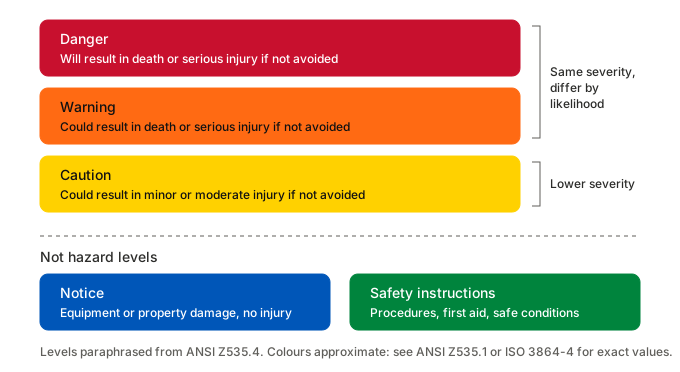
The difference between DANGER and WARNING is likelihood, not severity: both cover death or serious injury. Pick the word from the outcome and probability in your risk assessment, not from how alarming the label looks.
NOTICE and safety instructions are not hazard levels
ANSI Z535 uses NOTICE (blue panel) for messages that do not involve personal injury, such as risk of equipment damage. Green “Safety instructions” headers carry procedures. Neither belongs on a label warning of injury.
How ISO 3864-2 differs from ANSI Z535.4
ISO 3864-2:2016 uses the same three hazard levels and the same red, orange and yellow coding. It also allows a wordless format, in which a coloured hazard severity panel replaces the signal word, so one label works in every language.
The 2016 edition also requires at least one safety symbol shown in its ISO 3864 surround shape. A bare pictogram without the triangle or circle no longer counts as the main safety sign.
Which warning symbols go on a product?
Before reading any symbol, read its shape and colour. ISO 3864-1 fixes four meanings that apply to every safety sign on a product or in a building:
- Yellow triangle with black border: warning of a hazard.
- Blue circle: mandatory action, such as “read the manual” or “disconnect before opening”.
- Red circle with diagonal bar: prohibited action.
- Green square or rectangle: safe condition, first aid or escape route.
Once you know the four shapes, any product safety label can be decoded in a second, even when the text is in a language you do not read.
Symbols that electrical product standards call for
Product standards such as IEC 62368-1, IEC 61010-1 and IEC 60335-1 do not invent symbols. They call up symbols registered in IEC 60417, ISO 7000 and ISO 7010. The ones that appear most often on electrical equipment are these:
- Hot surface: IEC 60417-5041, or ISO 7010 W017 as a safety sign.
- Risk of electric shock: IEC 60417-6042, or ISO 7010 W012 as a safety sign.
- General caution (read the documentation): ISO 7000-0434.
- Protective earth terminal: IEC 60417-5019.
- Functional earth: IEC 60417-5018.
- Class II equipment (double insulation): IEC 60417-5172.
Only the first three are warnings. The earth and Class II symbols are identification markings: they tell the installer what a terminal or a construction is. Do not place them in a warning triangle.
Your product standard decides which symbols are mandatory, where they go and whether text must accompany them. The protective earth guide covers terminal marking in detail, and touch temperature limits explains when a hot-surface marking is allowed instead of a lower temperature.
Chemical products use a different system
Substances and mixtures carry the nine GHS hazard pictograms (red-bordered diamonds) under the CLP Regulation (EC) No 1272/2008 in the EU. They are not interchangeable with ISO 3864 product safety signs.
Which laws require warning labels on products?
EU product legislation rarely says “fit a label”. It requires the manufacturer to inform users of residual risks in a language they understand, and the harmonised product standard then specifies the marking. The legal hooks for most electrical and consumer products are these:
- Low Voltage Directive 2014/35/EU: Annex I requires the information needed for safe use to be marked on the equipment or, where that is not possible, in an accompanying document. Article 6(7) requires instructions and safety information in a language easily understood by end users.
- General Product Safety Regulation (EU) 2023/988: Article 9(7) requires clear instructions and safety information in a language easily understood by consumers, as determined by the Member State where the product is sold.
- Machinery Regulation (EU) 2023/1230: applies from 20 January 2027, replacing Directive 2006/42/EC. Annex III, section 1.7, covers information and warnings on the machine, including warning of residual risks.
The practical consequence is a language obligation: a label that carries text must be translated for every Member State you sell into. That is the strongest argument for symbol-led or wordless labels.
United States
No single federal law mandates ANSI Z535.4 for all products, but courts and experts treat it as the reference for an adequate product warning. Specific rules add their own wording, such as CPSC labelling rules under the Federal Hazardous Substances Act and California Proposition 65.
If you sell in both markets, design one label that satisfies both standards. Z535.4 permits ISO 3864-2 formats, so a red, orange or yellow panel with an ISO-shaped symbol and translated text usually works on both sides of the Atlantic.
Where should a warning label be placed?
Two tests decide placement: the label must be seen before the person is exposed to the hazard, and it must sit close to the hazard it describes. Typical locations on equipment are the following:
- Service covers and access panels, on the outside, so the warning is read before the cover comes off.
- Next to hot parts, heatsinks and exhaust grilles that an operator can touch.
- At the mains inlet or terminal block, for stored energy or multiple supplies.
- On guards over moving parts, for entanglement or crushing.
Walk the product through its life (unpacking, installation, use, cleaning, service) and check the label is visible at each step where the hazard can be reached.
Placement matters for a measurable reason. A meta-analysis of warning-label studies by Argo and Main found that whether people notice a warning depends on its vividness and its placement. Whether they act on it falls as the cost of complying rises.
How durable must a product warning label be?
A label must stay legible and attached for the life of the product. IEC product standards test this directly. IEC 62368-1 (Annex F), IEC 61010-1 and IEC 60335-1 all include a timed rub test, first with a cloth soaked in water and then with petroleum spirit.
After the test the marking must still be legible, and an adhesive label must not have curled or become removable by hand. Check the exact conditions in the current edition of your own product standard.
Material choices that pass
Office printer labels and paper face stock fail quickly. Use polyester or polycarbonate face stock with an overlaminate or subsurface print. Pick an adhesive rated for the surface temperature and energy of the substrate, especially on textured or powder-coated housings.
Labels near heat sources need extra care. A label next to a heatsink sees the same temperature cycling as the part it warns about, so specify the adhesive for the measured surface temperature, not the room.
When is a warning label the wrong answer?
A warning label cannot fix a hazard that design or guarding could remove. Test labs and market surveillance authorities will ask why the hazard was not designed out before they accept a label.
Over-labelling also has a cost. When every panel carries a sticker, users stop reading them, and the one label that matters gets lost. Users do not read the manual either, as covered in human factors in risk analysis.
Drop a label when the hazard is obvious to the intended user, when the same point already carries an equivalent warning, or when the message is about equipment damage and belongs in the manual.
Frequently Asked Questions
What are some examples of warning labels?
On electrical products the most common are hot surface, risk of electric shock, moving parts and stored energy (“disconnect all supplies before servicing”). Consumer products add choking hazard on toys, and chemicals carry the GHS pictograms.
What are the 9 hazard pictograms?
The nine GHS pictograms used under CLP are explosive, flammable, oxidising, gas under pressure, corrosive, acute toxicity, health hazard or harmful (exclamation mark), serious health hazard, and hazardous to the environment. They apply to chemicals, not to product safety labels.
How do you read a product safety label?
Read the colour first (red, orange or yellow for hazard level), then the shape of the symbol (triangle warns, blue circle instructs, red circle prohibits), then the text: hazard, consequence, action.
Who is responsible for warning labels on products?
The manufacturer designs and fits the label. In the EU, importers and distributors must check that the product carries the required safety information in the right language before they place it on the market or make it available.
Are warning labels a legal requirement?
Yes, whenever a residual risk remains that the user needs to know about. EU law requires the safety information; the product standard defines the marking. In the US, failure to warn is a ground for product liability claims.
Conclusion
A warning label means one thing: here is a hazard, here is what it does, here is how to avoid it. Choose the signal word from the risk assessment and the symbols from your product standard. Then prove durability with the rub test before the lab does it for you.
With the Machinery Regulation applying from January 2027 and ISO 7010 under revision, now is a good time to review your label set against current editions.
References. The claims in this article rest on the following sources.
- Regulation (EU) 2023/988 on general product safety, EUR-Lex, Article 9(7).
- Directive 2014/35/EU (Low Voltage Directive), EUR-Lex, Article 6(7) and Annex I.
- Regulation (EU) 2023/1230 on machinery, EUR-Lex, Annex III, section 1.7.
- Regulation (EC) No 1272/2008 (CLP), EUR-Lex.
- ISO 3864-2:2016, Graphical symbols: Safety colours and safety signs, Part 2: Design principles for product safety labels, ISO.
- ISO 7010:2019, Graphical symbols: Safety colours and safety signs, Registered safety signs, with amendments, ISO.
- ANSI Z535.4-2023, Product Safety Signs and Labels, ANSI.
- IEC 60417 and ISO 7000, Graphical symbols for use on equipment, IEC/ISO database.
- J. J. Argo and K. J. Main, “Meta-Analyses of the Effectiveness of Warning Labels”, Journal of Public Policy & Marketing 23(2):193–208, 2004.
- E. Earley, “The Latest Updates to the ANSI and ISO Product Safety Label Standards”, In Compliance Magazine, 2017.
Standard designations are used for identification only; Regulatory Decoded is not affiliated with or endorsed by IEC, ISO, ANSI, CENELEC or UL. Symbols shown on this page are original illustrations, not reproductions of registered artwork.