
The journey to bringing a new electronic product to market is often paved with rigorous testing, complex documentation, and the constant pressure of international standards. For many engineers and manufacturers, the two biggest hurdles are electrical safety. Electromagnetic compatibility (EMC) is also a major hurdle. Yet, these are frequently treated as separate, isolated milestones in the development cycle. This siloed approach is a dangerous gamble because the physical laws governing high-voltage insulation often sit in direct opposition to the principles of high-frequency noise suppression. If you optimize your board layout solely to prevent an electric shock, you might inadvertently cause your device to become a powerful radio transmitter. This situation could lead to failing emissions tests. Conversely, adding heavy filtering to quiet a noisy power supply can introduce leakage currents. These currents put the end-user at risk. This leads to a failed safety inspection.
Understanding the delicate interplay between these two disciplines is the hallmark of an experienced safety and quality technician. It requires a “regulatory decoded” mindset where every design choice is viewed through a dual lens: “Is this safe for the user?” and “Is this quiet for the environment?” In the modern landscape of highly integrated, fast-switching electronics, the margins for error are shrinking. A product that sails through a Hipot test might crash and burn during a conducted immunity sweep simply because a safety-mandated clearance gap created a massive inductive loop. To succeed, we must move away from the “fix it in the lab” mentality. We should embrace a holistic strategy that treats safety and EMC as a single, unified design requirement from the very first schematic capture.
Balancing electrical safety and electromagnetic compatibility (EMC) is fundamental for product compliance, certification, and market success. Yet, these two domains often compete: improvements in one can inadvertently degrade the other. A holistic, regulatory-driven strategy is therefore critical to avoid “solving” an issue in one area only to create new non-conformities elsewhere.
When Safety Requirements Affect EMC
- Increased Creepage & Clearance Distances
To pass high-voltage dielectric or insulation resistance tests (see our Hipot test Essentials guide or the official IEC 60664‑1), designers often spread conductors further apart. However, larger conductor spacing increases the loop area between primary and secondary grounds, boosting radiated emissions and impairing common-mode rejection in filters.Tip: Keep critical filter components close to the board edge and use tight ground vias to minimize loop area. - Enhanced Solid Isolation Barriers
Thickened insulating barriers (reinforced insulation per IEC 60950‑1) may alter PCB stack-up and force routing changes. This can fragment ground-plane continuity, increasing susceptibility to radiated and conducted disturbances.Tip: Plan insulation zones early in the PCB layout to preserve uninterrupted ground pours. - Higher Barrier Heights in Enclosures
Increasing plastic or ceramic barrier heights to meet safety creepage can push connectors and metallic parts farther apart. While safe, this rearrangement can alter shielding effectiveness, potentially increasing leakage through seams or gaps.Tip: Integrate gasketed or labyrinth seals in enclosure openings when extending barrier heights.
When EMC Measures Influence Safety
- Y-Capacitor Leakage Currents
To meet EMC limits (see IEC 61000‑4‑6), designers add line-to-ground (Y) capacitors. These inevitably introduce leakage currents (touch currents) that must remain below safety thresholds (e.g., 0.5 mA for Class II appliances per IEC 60601‑1).Tip: Choose X2/Y2 safety-rated capacitors with the lowest capacitance that still achieve EMC margins. - Mains Input Filters
Bulk EMI filters on line inputs reduce both differential- and common-mode noise, but they can increase earth leakage paths. Excessive filter capacitance or poor component placement may push leakage above certified limits.Tip: Use split-filter topologies or hybrid EMC components rated for lower leakage. The practical implementation of these filter topology choices — common mode chokes, X/Y capacitor placement and the leakage-current budget — is covered in detail in EMC Filter Design: Selecting and Placing Components to Pass Conducted Emissions. - Choke and Filter Thermal Rise
High-value common-mode chokes suppress emissions effectively but can self-heat. Inadequate derating or thermal management risks overheating, failing temperature-rise tests and compromising insulation.Tip: Incorporate thermal vias and small copper heat-spreaders under large inductors.

Leakage Current Behavior
Leakage current varies with frequency and system capacitance. Higher frequencies often see increased capacitive coupling, raising leakage during EMI testing even if mains-frequency touch current is acceptable. Understanding this spectral behavior helps in selecting Y‑capacitor values and grounding strategies. For deeper guidance, see the article on Leakage Current .
The Conflict of Layout Geometry
In the world of high-speed switching, every millimeter of copper acts as an unintended antenna or a potential safety breach. When designers prioritize electrical safety by increasing isolation distances, they inevitably create larger current loops that radiate electromagnetic energy, often leading to a failed EMC test at the final hurdle. To find the middle ground, designers need to move beyond basic schematic connectivity. They must treat the physical PCB layout as a critical component of the circuit itself.
Insight: The “No-Fly Zone” for Components Safety standards often dictate strict “keep-out” areas to maintain creepage and clearance, but these gaps can become EMI nightmares. Placing high-frequency bypass capacitors near the power pins can help. Ensure to respect safety distances to suppress noise at the source. This method does not compromise the dielectric integrity of the barrier.
Ground Planes: The Ultimate Compliance Tool
One of the most effective ways to harmonize safety and EMC is through the strategic use of solid ground planes. A continuous ground pour on a multilayer board provides a low-impedance path for return currents, which drastically reduces radiated emissions and improves immunity to external interference. Cutting these planes is sometimes necessary to meet high-voltage isolation requirements. However, doing so without a clear strategy can lead to “ringing” and noise spikes. These issues are undetectable by a simple multimeter.
Tip: If you must split a ground plane for safety, bridge the gap with a single, well-placed Y-capacitor to provide an RF return path while maintaining DC isolation. Note that the ground plane on your PCB is not the same thing as the earth reference used for safety bonding — treating them as equivalent is one of the most common causes of EMC failure. See Ground Plane and Earth Reference in EMC System Design for the physical distinction.
The Importance of a Unified Compliance Strategy
- Early Stage Co-Design
In schematic and PCB layout phases, involve both safety and EMC teams. Lay out creepage/clearance zones alongside filter footprints and grounding structures to minimize later conflicts. See our Design Collaboration Checklist for best practices. - Iterative Testing Sequence
Alternate safety and EMC pre-compliance checks:- Perform a hipot test → re-measure emissions → adjust filter values → re-verify dielectric strength.
- Document each step to identify regressions quickly.
- Documented Change Control
Maintain a design change log mapping each safety-or-EMC modification to test results. This traceability simplifies certification dossiers and demonstrates regulatory due diligence.Tip: Tag each version (e.g., v1.0_safety, v1.1_emc) in your version-control system.
The Synergy of Pre-Compliance Testing
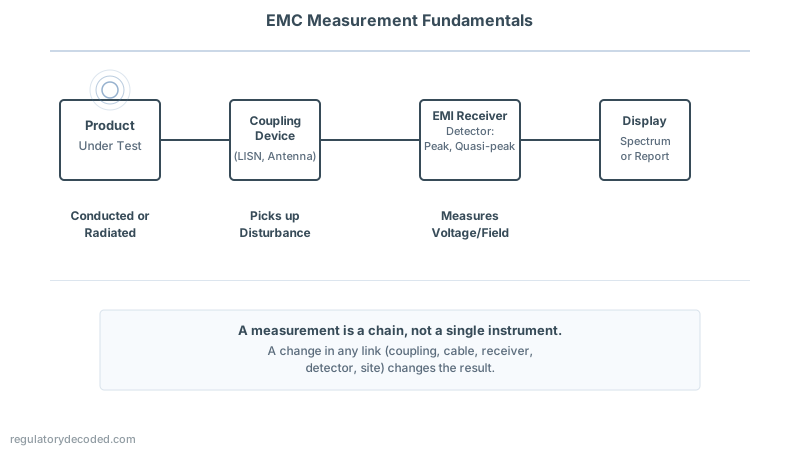
Relying solely on a final laboratory visit for certification is a high-risk strategy that often leads to expensive, last-minute redesigns. Instead, savvy technicians employ “pre-compliance” checks throughout the development cycle to catch conflicts between safety and EMC early on. This iterative approach allows you to verify that a new shielding bracket added for EMC doesn’t accidentally reduce a safety clearance distance below the allowable limit defined in standards like IEC 62368-1.
Useful Tip: Use a near-field probe during the prototyping phase to identify “hot spots” of radiation; if these align with your safety isolation barriers, consider adjusting your shielding or component placement immediately.
Useful Tips Summary
- Use compact, multilayer ground planes for both insulation and low-impedance returns.
- Select Y‑capacitors with minimal capacitance that still satisfy EMC margins.
- Employ split-filter or low-leakage EMC components to protect touch-current limits.
- Leverage 3D‑EMC simulation tools (e.g., CST Studio, Ansys HFSS) to predict radiated emissions impacts early.
- Always verify leakage and touch current across the full frequency band after final assembly.
Case Study: Switching Power Supply Interplay
A medical-grade switching PSU designer faced a dilemma:
- Problem: To pass IEC 60601‑1 dielectric testing at 4 kV, the team increased primary-to-secondary clearance on the PCB, pushing filter components to one side.
- EMC Impact: This separation increased the common-mode loop area, causing radiated emissions to exceed CISPR 22 limits above 300 MHz.
- Resolution:
- Introduced a localized metal shield between the primary side and filter region.
- Added a compact common-mode choke near the board edge, reducing loop inductance.
- Re-routed the ground return path to maintain creepage distances while minimizing RF loop area.
- Result: Both dielectric strength and radiated emissions passed on the first retest—avoiding costly redesign cycles.

References & Further ReadingReferences & Further Reading
Standards
- IEC 60664-1: Insulation coordination
- IEC 61000-4-6: Conducted immunity
- IEC 60950-1 / IEC 62368-1: IT equipment safety
- CISPR 22 / CISPR 32: Emissions limits
Related EMC resources on Regulatory Decoded
- Understanding EMC: The Basics — the emission vs immunity distinction and conducted vs radiated paths
- EMC Performance Criteria A, B and C: Owning the Grey Areas — how to defend immunity-test pass/fail decisions
- EMC Filter Design for Conducted Emissions — the practical component-selection guide
- Ground Plane and Earth Reference in EMC System Design — why these are not the same and how to handle them
- Why EMC Measurement Uncertainty Is So High — the chamber-to-chamber variability problem
- 10 EMC Mistakes to Avoid for Successful Certification — the pre-compliance checklist
By adopting a complete panorama approach, you co-design safety and EMC. Also, co-test and co-document them. This ensures your product sails smoothly through both certification and the marketplace.
By adopting a complete panorama approach, you co-design safety and EMC. Also, co-test and co-document them. This ensures your product sails smoothly through both certification and the marketplace.