On 20 January 2027 the Machinery Directive disappears, and every machine you place on the EU market from that day must meet Regulation (EU) 2023/1230. As of 18 October 2026, not one harmonised standard has been cited in the Official Journal under the new Regulation.
The Machinery Regulation 2027 deadline is fixed; the standards list is not. This article explains what a missing citation changes in your conformity route, which machines are pushed to a notified body, and how to prepare before the list appears.
What changes on 20 January 2027?
Directive 2006/42/EC is repealed with effect from 20 January 2027, and the Regulation applies from the same day. There is no sell-off period for new units: a machine placed on the market on 21 January must comply with the Regulation, whatever the design age.
Placing on the market is counted per unit
“Placing on the market” means the first making available of each individual unit, not of the model. Units still in your own warehouse on 20 January have not been placed yet. They ship under the Regulation, with a new EU declaration of conformity.
Machines already placed under the Directive before that date stay lawful and can keep moving through the supply chain. A substantial modification after 20 January triggers a new conformity assessment under the Regulation.
Are any harmonised standards cited under the Machinery Regulation yet?
No. The Commission issued its standardisation request to CEN and CENELEC in January 2025. The Commission machinery page, checked on 18 October 2026, says the first list under the Regulation can be expected ‘before the end of this year’.
The current Commission line, as reported by iBF on 28 September 2026, is that most standards now cited under the Directive will be cited under the Regulation before the end of 2026.
The gap analysis is well advanced. CEN and CENELEC presented its status on 14 September 2026. More than 800 harmonised standards are listed under the Directive, and CEN and CENELEC are checking them in the gap analysis.
Directive citations do not carry over
Presumption of conformity under Article 20 comes from harmonised standards whose references are published in the Official Journal under the Regulation itself, and also from common specifications (Article 20(6)).
A standard cited under the Directive gives you nothing on 21 January unless it has been re-cited.
Plan against two scenarios: the list lands before 20 January, or it lands after. The second scenario is the one this article is about.
What does a missing citation cost you?
Harmonised standards are voluntary. The essential health and safety requirements in Annex III are not. Without a cited standard, you lose the legal shortcut, not the ability to comply.
Presumption versus state of the art
With a cited standard, applying it means your machine is presumed to be in conformity with the essential requirements it covers (Article 20(1)). Without one, your technical file must show, requirement by requirement, how the design meets Annex III. You can still use EN ISO 12100 or EN ISO 13849-1 as the method.
In that case the standard is evidence of the state of the art, not a presumption. The difference shows up in the technical file. Each Annex III requirement needs its own justification, with the standard clause cited as your means, not as your proof.
The new requirements have no old standard at all
Some Annex III requirements are new: protection against corruption (section 1.1.9), the cybersecurity-related parts of safety and reliability of control systems (section 1.2.1), and requirements for self-evolving behaviour. No standard cited under the Directive covers them.
For sections 1.1.9 and 1.2.1, Article 20(9) also allows presumption from a cybersecurity certification scheme under Regulation (EU) 2019/881 whose reference is published in the Official Journal.
So even a timely list before the end of 2026 will not close the gap for connected machines unless it includes a standard for protection against corruption. That is the role of EN 50742.
Which machines need a notified body if standards are not cited?
This is the part most timelines skip. Article 25 of the Regulation links the conformity assessment route to the Annex I category of the machine, and for one category it links the route to cited standards.
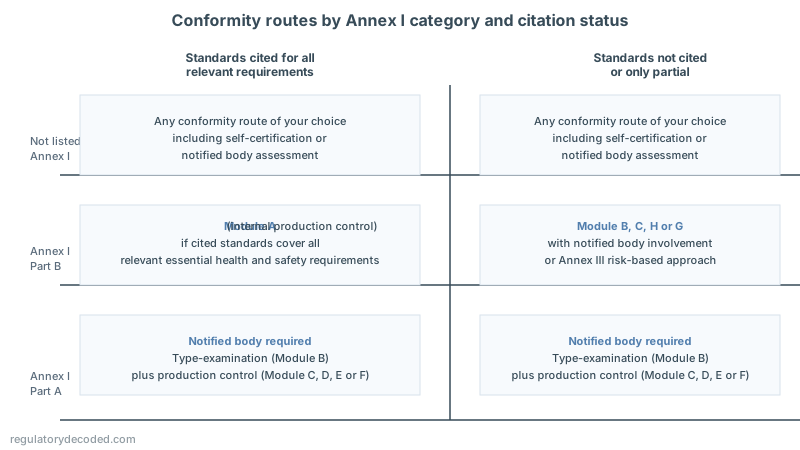
Here is how the three groups divide:
- Annex I Part A: a notified body is always required. You choose EU type-examination plus internal production control (Modules B + C), full quality assurance (Module H) or unit verification (Module G).
- Annex I Part B: you may use internal production control (Module A) only if you applied harmonised standards or common specifications specific to the category, with references published in the Official Journal, covering all the relevant essential health and safety requirements. Otherwise you must use Module B + C, H or G (Article 25(3), points (b) to (d)).
- Not listed in Annex I: internal production control (Module A), with or without standards.
The practical consequence is binary. If you build Part B machinery and planned self-certification, a missing or incomplete citation list moves you to a notified body for every unit placed from 20 January.
“All the relevant” requirements is the trap
The Part B condition is not “a standard exists for this machine type”. It is coverage of all relevant requirements by cited standards. A connected Part B machine whose type-C standard is re-cited in December still fails the condition if nothing cited covers section 1.1.9.
Part B includes categories familiar from Annex IV of the Directive, such as presses, woodworking machines and logic units for safety functions. Check your product against the Annex I text on EUR-Lex, not against the old Annex IV list.
Part A is small but new
Part A has six categories. Four are old Annex IV entries: removable mechanical transmission devices, their guards, vehicle servicing lifts and portable cartridge-operated fixing machinery.
The two new ones cover safety components and embedded systems with self-evolving behaviour using machine learning to ensure safety functions.
For Part A the citation status does not change the route. It may change how much evidence the notified body asks for.
Can common specifications fill the gap?
Article 20(3) lets the Commission adopt implementing acts that set common specifications when harmonised standards are missing or insufficient. Applying a common specification also gives presumption of conformity under Article 20(6).
In practice, no common specification has been adopted under the Regulation, and an implementing act needs the examination procedure under Article 48(3). Do not plan a Q1 2027 shipment on one appearing in time. Treat common specifications as a long-term safety net, not as your contingency.
How should you handle protection against corruption before a standard is cited?
Protection against corruption (Annex III section 1.1.9) is a new essential requirement, and no standard cited under the Directive covers it.
The CENELEC final draft, FprEN 50742:2026, addresses Annex III sections 1.1.9 and 1.2.1. It is not yet published or cited, so use it as a reference for your technical file, not as a presumption of conformity.
Our guide to protection against corruption in machinery sets out its scope and conformity approaches, so this article does not repeat them.
No draft text is reproduced here. Confirm every detail against the published EN once it is available.
How do you decide your route for Q1 2027 shipments?
Build the decision now, per product, and revisit it the day the Official Journal list is published. The table below combines the Annex I category with the citation status on the date each unit is placed on the market.
| Annex I status | Relevant standards cited (all EHSR) | Relevant standards not cited, or partial |
|---|---|---|
| Not listed | Module A, presumption of conformity | Module A, state-of-the-art justification per EHSR |
| Part B | Module A allowed | Notified body: B + C, H or G |
| Part A | Notified body: B + C, H or G | Notified body: B + C, H or G |
The middle row is where the calendar risk sits. For Part B machines shipping in January to March 2027, three actions reduce exposure.
- Contact a notified body designated under the Regulation now, and reserve capacity as a fallback. Designation provisions have applied since 20 January 2024, and notified-body capacity may be limited.
- Write the technical file against Annex III requirement by requirement, so it works with or without presumption.
- Record, for each unit, the placing-on-the-market date and the citation status on that date.
If the list arrives in time and covers everything, you have lost nothing. If it does not, the fallback is already booked.
Frequently Asked Questions
Can I still sell machines under the Machinery Directive after 20 January 2027?
Only units already placed on the market before that date. Any unit placed on the market from 20 January 2027, including stock still in your warehouse, must comply with Regulation (EU) 2023/1230 and carry a new EU declaration of conformity.
Do Machinery Directive harmonised standards give presumption of conformity under the Machinery Regulation?
No. Article 20 presumption applies to harmonised standards whose references are published in the Official Journal under the Regulation, and also to common specifications and qualifying cybersecurity certification schemes. Most Directive standards are expected to be re-cited before the end of 2026, but until then they are state-of-the-art evidence only.
Is EN 50742 mandatory for machinery?
No. Harmonised standards are voluntary. The requirement in Annex III section 1.1.9, protection against corruption, is mandatory. EN 50742 is the expected route to presumption of conformity for it once cited.
Which machines need a notified body under the Machinery Regulation?
All Annex I Part A machinery. Annex I Part B machinery also needs one unless the manufacturer applied cited harmonised standards or common specifications covering all relevant essential requirements. Machinery not listed in Annex I can use internal production control.
What happens to EC type-examination certificates issued under the Machinery Directive?
Under Article 52(2), EC type-examination certificates issued under Article 12 of Directive 2006/42/EC remain valid until they expire. Whether such a certificate can support a unit placed on the market after 20 January 2027 under the Regulation’s own procedures is a separate question; confirm that with your notified body.
Conclusion
The Machinery Regulation applies on 20 January 2027 whether or not the standards list is ready, and Directive citations give no presumption under it.
For Annex I Part B machinery, incomplete citations move self-certification to a notified body.
For connected machines, the gap is protection against corruption, so build that evidence into the technical file now.
The first Official Journal list will reshape these routes overnight, so keep the decision table live until it is published.
This article is technical guidance, not legal advice. Regulatory Decoded is not affiliated with or endorsed by IEC, ISO, CEN, CENELEC, ETSI or UL; standard designations are used for identification only.