
Electromagnetic compatibility, or EMC, might sound like a specialized topic reserved for lab coats and technical manuals. Yet, it plays a crucial role in making sure that electronic devices perform as intended, without causing or suffering from unwanted interference. When you flip a light switch, charge your phone, or turn on a wireless speaker, EMC rules ensures those devices behave reliably and safely. And while EMC springs to life most visibly during product testing, its principles shape design choices from day one. In this article, we will explain EMC in straightforward terms and explore why it matters for product functionality.
What Is EMC?
EMC stands for two main ideas: emissions and immunity. Emissions refer to unwanted electromagnetic energy generated by a device. Immunity, or susceptibility, describes how well a device resists outside interference that could affect its operation. In practice, EMC is about balancing these two sides: ensuring that your product does not disrupt other equipment and that it can perform properly amid various electromagnetic “noises” around it.
Electromagnetic Emissions
Every electronic circuit generates small amounts of electromagnetic energy. Some of it is intentional, think of a Bluetooth radio chip radiating Bluetooth signals. But other emissions come from high-speed digital edges, switching power supplies, or even the motion of mechanical components. These unwanted emissions can travel through the air (radiated emissions) or along cables and wiring (conducted emissions). If left unchecked, they may interfere with nearby equipment, causing glitches in a sensitive sensor, distorted audio in speakers, or even safety hazards in critical systems.
For a practical dive into how conducted emissions are managed at the power entry point — common mode choke selection, X/Y capacitor sizing, and the trade-off between filter performance and leakage current — see EMC Filter Design: Selecting and Placing Components to Pass Conducted Emissions. For broader context, the In Compliance Magazine fundamentals article is a good overview.

Electromagnetic Immunity
Devices in the real world are rarely isolated. They share space with Wi-Fi routers, cell towers, fluorescent lighting, electric motors, and even the human body’s own electrical signals. All these sources can generate transient spikes, continuous noise, or electrostatic discharges. A product that lacks immunity might reset unexpectedly, lose data, or behave unpredictably in such an environment. EMC testing evaluates how a design responds to common disturbance waveforms, like electrostatic discharge (ESD), radio-frequency (RF) fields, and electrical fast transients.

Why EMC Matters for Functionality
At first glance, EMC might seem like a box-checking step on the path to certification. But ignoring EMC in the early stages of design often means delayed projects, unexpected redesign costs, or even product recalls later on. Below are key reasons why EMC influences functionality:
Reliability in Real-World Conditions
When electromagnetic emissions from nearby equipment intrude on a device’s circuitry, the result can be anything from a flickering display to a complete system freeze. A fitness wearable that resets every time you ride a motorbike, or a medical monitor disturbed by nearby cell phones, undermines customer trust. Good EMC practices—such as careful PCB layout, proper grounding, and shielding—help maintain consistent performance whether your product is used in a home, an office, or an industrial plant.
Meeting EMC Regulatory Requirements
Regulatory bodies around the world have established emission and immunity limits. For example, the European Union’s EMC Directive (2014/30/EU) sets standards that products must meet before they can bear the CE marking. In the United States, the Federal Communications Commission (FCC) Part 15 requirements govern unintentional radiators. Certification labs will test products against these standards. If emissions exceed limits or immunity levels fall short, companies face redesign and retesting, both of which add time and cost.
Ensuring Safety and Avoiding Hazards
In some cases, electromagnetic disturbances can create safety risks. Consider a medical device used in an operating room. If it malfunctions due to interference from nearby surgical lighting, patient harm could result. In aerospace or automotive systems, electromagnetic interference (EMI) might compromise navigation or braking electronics. By designing for EMC, developers reduce the risk of functional failures that can lead to accidents or injuries. Balancing EMC and Electrical safety is also another critical point, to be kept into consideration. Hipot test or Leakage Current have a direct impact on insulation and filtering, they should be considered together with EMC requirements.
Facilitating Product Certification and Market Access
Passing EMC tests is a prerequisite for many markets. Even if a product works flawlessly in a controlled lab, failing EMC compliance tests can prevent it from being sold. Early attention to EMC, using pre-compliance scans or simulation tools, can catch potential issues before committing to a full certification run. And once a product has the required EMC certification, it gains credibility with distributors, retailers, and end customers.
Key Factors That Affect EMC
Recognizing what influences EMC performance helps engineers make better design choices. Below are some factors to keep in mind:
- Circuit Layout and Grounding
A poor PCB layout can turn simple digital switching into a radio transmitter. Traces that carry high‐speed signals should be routed away from antenna‐like loops, and ground planes should be continuous. And while stitching vias might seem like minor details, they can dramatically reduce emissions. - Shielding and Enclosures
Metal enclosures or shielded cables act like Faraday cages, blocking unwanted emissions. Think of shielding as a protective shell around sensitive circuitry or antennas, preventing stray fields from getting in or out. - Filter Components
Installing filters on input lines, power rails, or I/O ports can stop conducted noise from escaping or entering a device. A well‐chosen common‐mode choke or an RC filter at the right location can suppress troublesome high‐frequency energy. - Cable Management
Long cables can act like antennas. Any external cable connected to your device—power cords, USB lines, even headphones, needs attention. Ferrite beads, twisted pairs, or proper cable routing can reduce radiated emissions from these conductors. - Software Techniques
Believe it or not, software can help with EMC, too. Some microcontrollers offer spread‐spectrum clocking options to flatten emission profiles. And firmware routines that stagger the timing of high-current activities (like motor starts) can help avoid sudden current spikes.
Tips for Early‐Stage EMC Success
Designing with EMC in mind from day one makes the path to certification much smoother. Here are some practical pointers:
Start with a solid ground plan. A continuous ground plane in a multilayer PCB reduces impedance and lowers loop areas. If you have a single-layer board, consider adding a copper pour to serve as a makeshift ground plane. Important: the ground plane on your PCB is not the same thing as the earth reference used for safety bonding. Confusing them is one of the most common sources of EMC failure — see Ground Plane and Earth Reference in EMC System Design for how to handle both correctly.
• Use decoupling capacitors close to power pins.
Placing capacitors right at the device pins helps contain high-frequency switching currents. And using multiple values (for example, 0.01 µF, 0.1 µF, and 10 µF in parallel) covers a broader frequency range.
• Run a quick pre‐compliance scan.
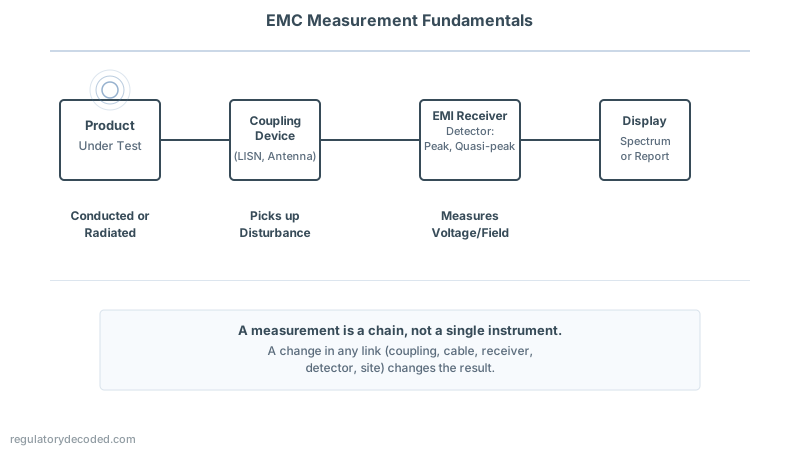
Investing in a near‐field probe and a spectrum analyzer, or renting a testing time at a lab, lets you catch major emission spikes before full compliance testing. Even a simple “sniff” around troublesome components can reveal design flaws.
• Keep cables short and avoid loops.
When routing connectors to the board edge, keep cables as direct as possible. And if you must loop a cable (for instance, cable management inside a chassis), twist it or add ferrite cores to minimize EMI.
• Model early with simulation tools.
Many EMC issues stem from unintended resonances. Free or low-cost tools, such as circuit simulators or field solvers, can reveal problem areas before cut metal or etched copper. Simulations also help evaluate different shielding strategies without physical prototypes.
If you want to further read about how to design for EMC compliance, here is a good article from one of my favorite magazines, In Compliance
EMC Standards and Regulations
Regulations vary by region and application. Below is a brief overview of key EMC reference points:
- International Electrotechnical Commission (IEC) 61000 Series.
The IEC 61000-4-2 standard covers immunity to electrostatic discharge. IEC 61000-4-3 addresses radiated RF immunity. And IEC 61000-3-2 and 61000-3-3 define harmonic current and voltage fluctuation limits for power supplies. Manufacturers aiming for a global market often design to these harmonized standards. - European Union EMC Directive (2014/30/EU).
To sell in the EU, most electronic products must meet this directive. The directive references specific EMC standards—such as EN 55032 (radiated and conducted emissions) and EN 55024 (immunity for information technology equipment). - FCC Title 47, Part 15 (United States).
Devices classified as “unintentional radiators” (digital circuits without an intentional RF function) must comply with Part 15 Class A or Class B emission limits. Class B covers residential use and is stricter; Class A applies to industrial or business environments. - CISPR 11/32/35 (Commercially Available Radio-Frequency Equipment).
CISPR standards set emission limits for industrial, scientific, and medical (ISM) equipment, multimedia devices, and audio/video gear. Complying with CISPR often satisfies multiple regional requirements.
Useful Tips Before You End the Project
As you wrap up the final prototype or prepare for certification, keep these closing‐stage tips in mind:
• Review all connector cables.
Check that every cable, power, USB, audio, Ethernet, has the right filtering or ferrite. Even if individual components pass tests, an unfiltered cable can spoil the entire system’s compliance.
• Check shield continuity.
If you use a metal enclosure, verify that seams, gaskets, and shielded connectors maintain low impedance. A loose chassis screw or missing gasket can become a leak point for emissions.
• Run both emission and immunity checks on final assembly.
Testing individual PCBs is only half the story. Once everything is in its enclosure and cables attached, rerun major test cases. Sometimes components interact in unexpected ways.
• Document your fixes thoroughly.
Document your fixes thoroughly. If you add ferrite beads, change component placements, or adjust grounding, record each step. That way, if a client asks, you can explain exactly how you met the EMC requirements. One more thing to document: EMC measurement uncertainty is unusually high (3–5 dB across accredited labs is normal), which means a product that passes with a 1 dB margin at one lab can fail at another. See Why EMC Measurement Uncertainty Is So High for how to design in that margin from the start.
Conclusion
Designing for EMC is essential to ensure reliable product functionality, user safety, and regulatory approval. By understanding emissions and immunity, abiding by relevant standards, and following good design practices, engineers can create devices that work seamlessly in today’s crowded electromagnetic environment. EMC compliance may involve extra effort early on, but it pays off by reducing delays, minimizing redesigns, and building customer confidence.