Your immunity test report says “Criterion B; pass.” What does it really mean? Who decided what B means for your product?
The reality is that You did.
EMC performance criteria are one of the grey areas in immunity compliance. The standard sets the test and assigns a criterion; defining what “acceptable” means for your product is left to you. Left open, that definition returns as a failed test or a rejected report.
This article tries to solve some of the unclear points, and shows you how to design and prepare so the grey areas are closed before the chamber door does, and how to own that judgement under Directive 2014/30/EU.
Why are EMC performance criteria so often misunderstood?
Ask three engineers what criterion B requires and you will get three answers. That is not incompetence, and it is not a defect in the standard. It reflects a deliberate division of responsibility.
The three letters look like a complete classification. They are a framework: the standard supplies the structure, and the manufacturer supplies the product-specific meaning.

The Criteria is not the requirement
A criterion describes the shape of acceptable behaviour: does the function survive, recover on its own, or need a hand? It says nothing about which functions matter, or how far each one may drift.
That content comes from your functional description. Without it, the letter is an empty container, and everyone involved fills it differently.
Whether a given degradation is acceptable — say, a 5 % drop in motor speed during an ESD burst — is a judgement that belongs to the producer and the end user, not to the standard. The standard assigns the letter; only you can decide what performance shift behind that letter your application tolerates.
That distinction must be clear to the technician running the test, because without it the chamber becomes the place where pass and fail are improvised rather than verified.
The standard defines the test; you define the verdict
Immunity standards specify the disturbance in detail: waveform, level, dwell time and test setup. What counts as acceptable behaviour under that disturbance is assigned to the manufacturer.
That split is deliberate. A standard covering thousands of equipment types cannot know whether a 200 ms output glitch is trivial or dangerous in yours.
Only you can, and it is your taks o correctly identify and document what can be considered acceptable and what not. It is also your task to correctly transfer the informations to the technician doing the tests.
Nobody owns the judgement until something fails
On most projects the criteria are never formally assigned to anyone. The designer assumes the test engineer will define them. The test engineer assumes the product specification already has.
The gap surfaces on test day, under time pressure, with the product already in the chamber. That is the worst available moment to decide what “acceptable” means.
When no one has claimed the judgement, the technician inherits it by default. They become the person who decides whether a flicker on a display qualifies as degradation, whether a momentary relay drop counts as a loss of function, and whether recovery happened fast enough. They were hired to run the test correctly, not to reverse-engineer your design intent. Expecting them to improvise acceptance limits during a live sweep is not a gap in their competence, it is a gap in yours. A one-page functional brief, handed over before the test begins, closes it entirely: it tells the operator what to watch, what numbers to compare against, and when to stop and call the result.
Where do these grey areas turn into failures?
An undefined criterion rarely stays quiet. It resurfaces at the point where fixing it costs the most.
- Mid-test stalemate. The product glitches, nobody can say whether that counts, and the slot burns while the room argues. Chamber time is billed either way. Had the technician received a threshold — say, “output offset exceeding 50 mV for more than one second is a fail” — the call takes five seconds, not fifty minutes.
- Report rejected downstream. A customer, OEM or distributor reviews your file, finds a criterion with no stated threshold, and declines to accept the report.
- A failure invented after the fact. With no baseline recorded, an ambiguous observation gets written up as a fail that a properly defined criterion would have passed.
- Redesign chasing a phantom. Engineering hardens a circuit against behaviour that was acceptable all along, because nobody wrote down that it was.
- Market surveillance challenge. An authority asks how you concluded the product meets Annex I. “The laboratory said criterion B” is not an answer.
Every one of these traces back to a decision that costs nothing at the design stage and a great deal afterwards, which is why criteria belong in the same early conversation as the common EMC mistakes that sink certification.
What do performance criteria A, B and C actually mean?
Immunity standards classify what your product is allowed to do while a disturbance is applied, and three letters carry the entire judgement. If the emissions and immunity split is new to you, Understanding EMC: The Basics covers the ground first.
Criterion A means normal operation continues throughout the test, within the performance level you specified. No loss of function, no observable degradation.
Criterion B allows temporary degradation or loss of function during the disturbance, provided the product recovers by itself once the disturbance stops. No operator action is permitted.
Criterion C allows loss of function that persists until an operator intervenes; a reset, a power cycle, a manual restart. Recovery is allowed, but it is not automatic.
The letters look self-explanatory. The performance level behind them is not. Each criterion is anchored to a level the manufacturer states, which is why two products can share a criterion and be judged very differently.
Basic, generic and product standards do different jobs
The IEC 61000-4 series defines how to apply a disturbance: waveform, level, duration, test setup. It does not tell you whether your product passed.
Pass or fail comes from the generic immunity standards or from a product or product-family standard. These allocate a criterion to each phenomenon.
None of them can define your product’s functions for you. Confirm the exact allocation against the current edition of the standard that applies to your product, since allocations change between editions.
Why does the EMC Directive leave “acceptable” undefined?
Annex I, point 1(b) of Directive 2014/30/EU states that equipment must have a level of immunity to the electromagnetic disturbance to be expected in its intended use “which allows it to operate without unacceptable degradation of its intended use.”
That is the whole immunity requirement. The Directive never defines “unacceptable”, and it could not sensibly do so, acceptability depends on what the product does.
The judgement is pushed to you deliberately. Annex II, point 2 requires the EMC assessment to take account of all normal intended operating conditions, and every configuration you identify as representative of intended use.
So the standard hands you a letter and the law hands you the definition behind it. Performance criteria are where the two meet, and where most technical files are thinnest.
How do you program EMC performance criteria into a test plan?
Write the criteria before the product reaches the chamber, not after a plot goes wrong. Six steps turn a letter into something a third party can re-test.
- Write a functional description. List every function the product performs, in words a user would recognise. This is the “intended use” baseline your criteria are measured against.
- Select representative operating modes. Cover the configurations that stress the product electrically and the ones typical of normal use. Annex II asks for both, not one or the other.
- Define a monitored parameter for each function. Analogue output within a stated percentage of set point, communications with zero corrupted frames, relay state unchanged, display readable. A criterion you cannot observe is not a criterion.
- Set the acceptance threshold numerically. “No significant deviation” is not a threshold. Anchor the number to something real: the product’s own accuracy specification, a control-loop tolerance, a datasheet claim you already publish.
- Define recovery explicitly. State the maximum time you accept for self-recovery under criterion B, and state what counts as operator intervention under criterion C.
- Record who judges, and how. Name the instrument, the sampling rate, and the person or script that makes the call.
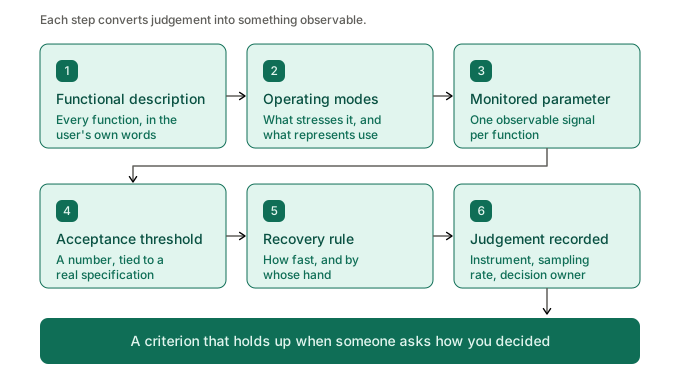
Each step converts a subjective letter into an observable fact that a market surveillance authority could reproduce.
Design for the criterion you intend to claim
Choosing a criterion is a design decision, not a reporting one. If you need criterion A on a measurement output, the filtering, shielding and firmware retry strategy have to exist before the product reaches the laboratory. For the filtering side specifically, common mode choke selection, Y-capacitor sizing against the leakage current budget, and filter placement at the power entry point — see EMC Filter Design: Selecting and Placing Components to Pass Conducted Emissions.
The EMC compliance hub collects the design-stage decisions that make that achievable.
Deciding late forces the reverse: you test first, then argue for the weakest criterion that can still be justified. Reviewers recognise that pattern immediately.
Monitoring is part of the design, not an afterthought
Your monitoring chain sits in the same field as the product. If the test disturbs your oscilloscope or your USB logger, you will record failures that belong to the instrumentation. The same logic applies to how the EUT itself is bonded to the chamber ground plane; a misunderstood ground/earth reference can shift immunity-test pass/fail by several dB. See Ground Plane and Earth Reference in EMC System Design for the physical distinction.
Use fibre links, opto-isolation or battery-powered loggers where you can. Decide before the test how you will separate a genuine product failure from a monitoring artefact.
Where do EMC performance criteria usually go wrong?
Most disputes trace back to the same handful of gaps, and all of them are cheap to close at the planning stage.
- No stated recovery time under criterion B. The standard requires self-recovery. It rarely says how fast. Without a number, “eventually” becomes arguable.
- A watchdog reset counted as self-recovery. If the product reboots and loses its state, accumulated data or position, it restarted rather than recovered. Say which one you accept.
- Functions nobody monitored. A function absent from the test plan is a function with no evidence. Reviewers read the functional description against the test log.
- Thresholds written to fit the result. Criteria set after a failure appear in the file with no engineering rationale behind them. This is precisely the practice that draws regulatory distrust.
- Safety-related functions assigned criterion B or C. A protective function that drops out during a surge is a safety argument, not an EMC convenience. This is where electrical safety and EMC compliance stop being separate workstreams.
- Measurement uncertainty ignored at the boundary. A result sitting on your threshold is not a pass until you state how uncertainty is treated, and EMC measurement uncertainty is high enough to matter.
Every one of these is inexpensive to fix in the test plan and expensive to fix after the report is issued.
How do you defend performance criteria when the standard leaves room for interpretation?
Interpretation is part of applying any immunity standard. What matters is that your reasoning exists in writing before anyone asks to see it.
Follow the hierarchy, then document the gap
Apply the product standard first, the product-family standard next, the generic standard last. Where a dedicated product standard exists, its criteria override the generic allocation. The same hierarchy logic runs through international standards for safety and EMC.
Where none of them addresses a specific function, say so explicitly in the technical file. Then state the criterion you applied and why it satisfies Annex I.
Argue from consequence, not from convenience
Tie each criterion to what happens to the user when the function degrades. A display flicker on a kitchen timer and a flicker on a patient monitor are not the same event.
That reasoning is a risk argument. It is the one thing a self-declared criterion cannot survive without.
Agree it with the laboratory in writing, before the test
Send the functional description, the operating modes and the thresholds to the laboratory as part of the test plan. Get the acceptance back in writing.
A criterion the laboratory helped define and recorded in the report is far harder to dismiss than one that appears only in your own file.
Why does the harmonised standards freeze make your criteria more exposed?
Article 13 of Directive 2014/30/EU grants presumption of conformity only to standards whose references are published in the Official Journal. That route is currently narrowing.
The EMC list has had no substantive amendment since Commission Implementing Decision (EU) 2022/910 of 9 June 2022. Two court rulings explain why.
The Commission’s EMC harmonised standards page remains the authoritative source for what is currently cited.
The James Elliott judgment (C-613/14) established that harmonised standards form part of EU law, which raised the Commission’s assessment burden considerably. Assessments of EMC standards have stalled since.
The Malamud ruling (C-588/21 P, March 2024) held there is an overriding public interest in free access to harmonised standards. ISO and IEC responded by bringing proceedings against the Commission in Case T-631/24.
Since the start of 2025, no ISO- or IEC-based harmonised standard has been cited in the Official Journal. Most EMC standards are EN IEC adoptions, so the effect on the EMC Directive is disproportionate.
The standards community is already working on this
Performance criteria are a recognised item on the agenda, not a complaint from the sidelines.
The CEN-CENELEC coordination group for the EMC Directive lists manufacturer-defined performance criteria, statistical methods and measurement uncertainty among the technical points being resolved for future citation, as In Compliance Magazine reported in July 2026.
That is useful context for your own file. The judgement you document today is the same judgement the standards bodies are working to make more consistent tomorrow.
What the freeze changes for you
Presumption of conformity reverses the burden of proof. Without it, nobody has to prove your product non-compliant — you have to prove it compliant.
Your EMC performance criteria then stop being a test-report formality. They become the substance of your Annex I argument.
Legal conformity takes precedence over conformity to standards. Meeting Annex I is the obligation; the standard is only the evidence you chose to use.
Frequently Asked Questions
What are performance criteria A, B and C in EMC testing?
They classify how a product may behave during an immunity test. A means normal operation continues uninterrupted, B allows temporary degradation with automatic self-recovery, and C allows loss of function until an operator intervenes.
Who defines EMC performance criteria, the standard or the manufacturer?
Both. The standard allocates a criterion letter to each phenomenon. The manufacturer defines the performance level that the letter is measured against, in the functional description and the technical documentation.
Is criterion B a pass if my product resets itself?
Only if you stated in advance that a reset is acceptable. A reboot that loses state, data or position is a functional loss, and it must be judged against what your functional description promised.
Are EMC standards still harmonised under the EMC Directive in 2026?
Existing citations remain valid, but the EMC list has had no substantive amendment since June 2022, and no new ISO- or IEC-based standard has been cited in the Official Journal since the start of 2025.
What do I do if no harmonised standard covers my product’s immunity?
You still have to meet Annex I of Directive 2014/30/EU. Use the most relevant standard as technical evidence, document why it applies, and justify your performance criteria against intended use.
Why do EMC standards not define what “acceptable degradation” means?
Because acceptability depends entirely on the product. A standard written for thousands of equipment types cannot judge whether a brief output glitch is harmless or hazardous in yours, so it delegates that judgement to the manufacturer.
Conclusion
Performance criteria are the grey area of immunity compliance, and the grey exists by design: the Directive’s phrase “unacceptable degradation” becomes a number only when you write one.
Criteria decided before the test, tied to monitored parameters and agreed with the laboratory, survive review; criteria written around a result do not.
With harmonised citations frozen, the burden of proof stays with you, which makes your technical file the compliance argument rather than a supporting note.
The next twelve to twenty-four months of Commission and CENELEC activity will decide whether that burden shifts back, and manufacturers who already document their criteria properly will barely notice the difference.